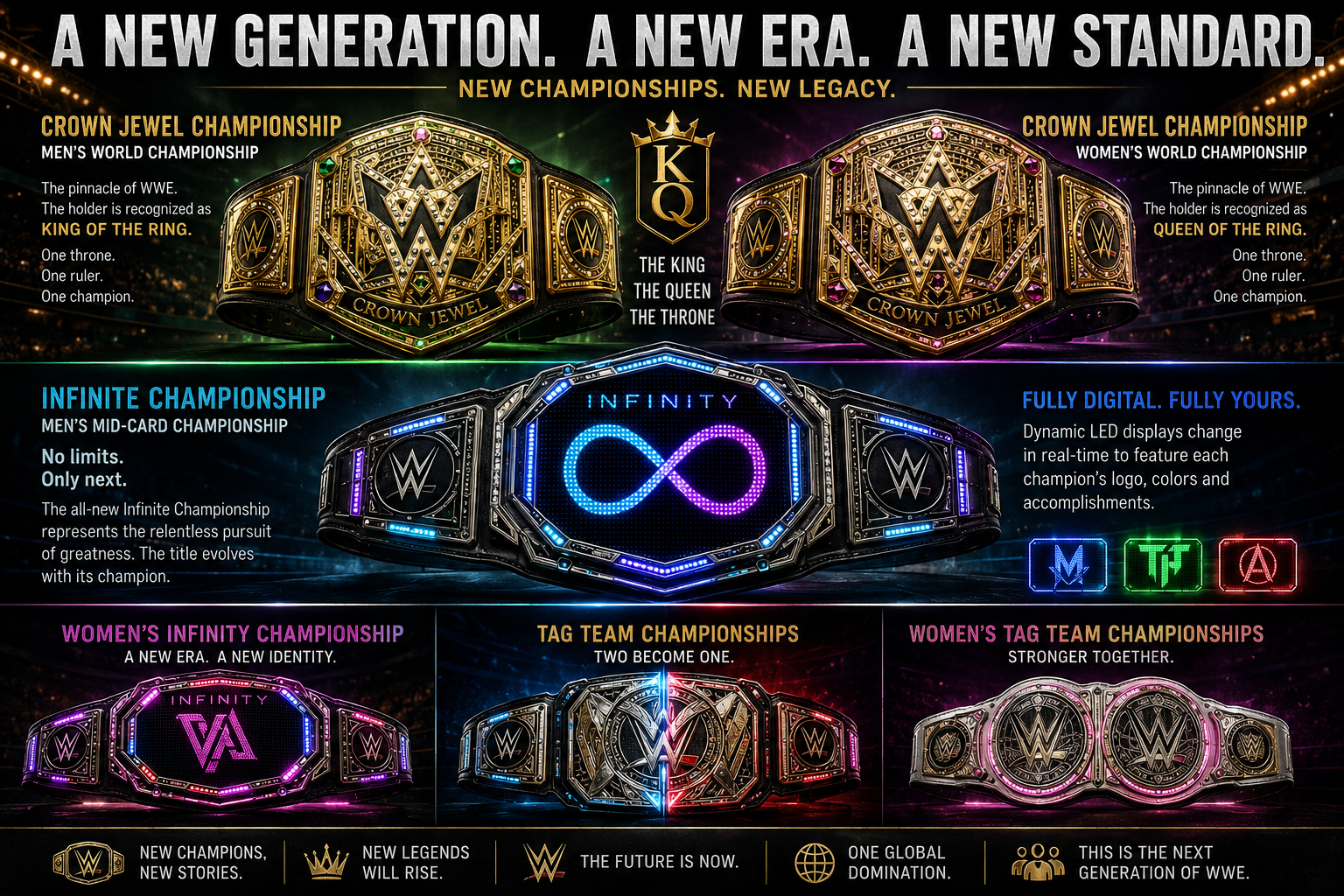
A new generation of WWE deserves championships that belong to them. The Crown Jewel Championship already looks worthy of being WWE’s top prize, so instead of appearing once a year, it should become the company’s permanent world championship—with its holders officially recognized as King and Queen of the Ring.
Even the legendary Intercontinental Championship eventually deserves a proper retirement. In its place, WWE could introduce the futuristic Infinity Championship inspired by WWE 2K, complete with LEDs and a fully digital face that instantly changes to reflect each new champion.
The same philosophy should extend throughout WWE’s women’s and tag team divisions: new names, new designs and new identities. The championships of the past created decades of history. Now it’s time to give the Next Generation the opportunity to create traditions of their own.
What’s the verdict?
A NEW GENERATION NEEDS NEW CHAMPIONSHIPS
If WWE is serious about entering a new generation, then the championships need to evolve with it.
For years, the giant WWE logo has become synonymous with the company’s major championships. You can argue whether that is a good thing or a bad thing, but there is no denying the branding works.
You see that giant WWE logo and immediately know what company the championship belongs to.
But there is a difference between recognizable branding and stagnation.
Every generation deserves championship designs that belong to that generation.
The Winged Eagle Championship belonged to an era.
The Big Eagle Championship belonged to another.
The Spinner Championship, for better or worse, became inseparable from John Cena’s rise and the generation that followed him.
The Big Gold Belt carried its own history and prestige across multiple eras and companies.
Those belts became part of the identity of the wrestlers who carried them.
And if WWE is going to create a true Next Generation, those wrestlers should not simply inherit another variation of the same giant-logo championship design.
They deserve something of their own.
The funny thing is, WWE may have already created the perfect replacement.
THE CROWN JEWEL CHAMPIONSHIP SHOULD BE WWE’S TOP TITLE
I’ve said before that I’m not a fan of building entire premium live events around specific match types.
Hell in a Cell is the obvious example.
Hell in a Cell used to mean something.
It was the match you went to when a rivalry had reached the point where a normal wrestling match was no longer enough.
Then WWE created an annual Hell in a Cell event, and suddenly creative had to manufacture at least one rivalry every year that justified putting people inside the structure.
The match stopped being the natural conclusion of a story and became an obligation on the calendar.
Money in the Bank has a similar problem.
The ladder match itself is great.
The concept is great.
But when Money in the Bank becomes its own annual show, you are automatically removing six, seven or eight of your top performers from other potential matches because they have to be in the ladder match.
The calendar begins dictating the story instead of the story dictating the match.
More recently, I think WWE has made a similar mistake with the Crown Jewel Championship.
Because that championship should not exist simply to be brought out once a year.
Look at the thing.
The Crown Jewel Championship looks like a million bucks.
Actually, it probably looks like substantially more than that.
It is one of the best-looking championships WWE has produced in decades.
And I’ll go one step further.
The Winged Eagle Championship remains my favorite championship design WWE has ever used, and I know I’m not alone there.
But the Crown Jewel Championship may be the closest WWE has come since then to producing a championship that immediately looks important.
It looks expensive.
It looks prestigious.
It looks like something that should be sitting at the very top of WWE.
So put it there.
The Crown Jewel Championship should become WWE’s primary championship.
Not an annual trophy.
Not something somebody wins in Saudi Arabia and then effectively forgets about.
The championship should be on television every week.
It should headline WrestleMania.
It should headline SummerSlam.
It should be the championship everybody wants.
You can absolutely still hold Crown Jewel every year.
The event doesn’t need to disappear simply because the championship becomes permanent.
If anything, the event suddenly gains more significance because it shares its name with the most important championship in the company.
Now Crown Jewel is not simply an annual event where WWE hands somebody a giant decorative championship.
It becomes an event built around the crown jewel of WWE.
That gives the name meaning.
THE CHAMPION BECOMES KING OR QUEEN OF THE RING
And this is where I think the championship can become even more important.
The championship itself remains the Crown Jewel Championship.
But the person holding it receives a formal title.
The men’s Crown Jewel Champion becomes:
King of the Ring.
The women’s Crown Jewel Champion becomes:
Queen of the Ring.
That changes the presentation immediately.
Instead of the King of the Ring tournament being something WWE occasionally brings back where the winner gets a crown, robe and scepter and spends the next few months pretending to be royalty, the phrase actually means something.
And yes, Booker T, I’m looking at you.
King Booker was entertaining.
But that doesn’t mean WWE needs to keep repeating the same gimmick forever.
Winning King of the Ring should no longer mean you get to walk around dressed like someone escaped from a Renaissance festival.
It should mean you have earned the right to pursue the throne.
And once you win the Crown Jewel Championship, you become the King.
Not symbolically.
Officially.
Commentary can refer to the champion as King of the Ring throughout the reign.
The same applies to the women.
Now you have terminology that automatically makes the championship feel different from every generic “world championship” WWE has used over the years.
A challenger isn’t simply pursuing a belt.
They are pursuing the throne.
A champion doesn’t simply lose a title.
The King has been dethroned.
The Queen has fallen.
A new King has been crowned.
That language practically writes the stories for you.
And more importantly, it creates a championship identity that belongs to this generation.
KING OF THE RING BECOMES A REAL PATH TO THE CHAMPIONSHIP
This also gives the King of the Ring tournament an actual purpose again.
The tournament should return to being a one-night event.
No stretching it over several weeks.
No random semifinal on Raw followed by another semifinal on SmackDown and then a final at some unrelated PLE.
One night.
One tournament.
One survivor.
That should mean something.
And instead of the winner receiving a costume, the winner receives a guaranteed Crown Jewel Championship opportunity.
Now King of the Ring becomes one of the most important achievements in WWE.
You survive the tournament.
You earn the right to challenge the King.
Then if you beat the King, you become the King.
That is simple.
That is easy to understand.
And that is infinitely more meaningful than winning a crown for a few months.
The same system works for Queen of the Ring.
Now both tournaments create championship contenders and feed directly into WWE’s larger annual structure.
That is how traditions should evolve.
You don’t have to erase King of the Ring.
You make King of the Ring matter again.
EVEN THE INTERCONTINENTAL CHAMPIONSHIP CAN’T LAST FOREVER
This is where I know I’m going to lose some people.
Because there are certain things wrestling fans consider almost untouchable.
The Intercontinental Championship is one of them.
I understand why.
I love the Intercontinental Championship.
It has been the premier mid-card championship in professional wrestling for more than half a century.
Think about the people who have carried it.
Randy Savage.
Ricky Steamboat.
Mr. Perfect.
Bret Hart.
Shawn Michaels.
Razor Ramon.
Chris Jericho.
The Rock.
Triple H.
Edge.
Randy Orton.
Gunther.
The list goes on and on.
For generations, becoming Intercontinental Champion often meant WWE believed you were capable of becoming something more.
It was the workhorse championship.
It was the championship for the wrestler expected to go out and have one of the best matches on the show.
Sometimes it was even more interesting than the world championship.
That history matters.
But history does not mean something has to exist forever.
Eventually even the greatest traditions reach a point where retiring them adds to their prestige instead of diminishing it.
And I think the Intercontinental Championship has reached that point.
Let it ride off into the sunset.
Not because it failed.
Because it succeeded.
It has done its job for more than fifty years.
Let the final champion retire it with dignity.
Put it in the Hall of Fame.
Display the different versions throughout WWE history.
Celebrate every legendary reign.
Then let the next generation have something new.
THE WWE INFINITY CHAMPIONSHIP
I struggled with what should replace the Intercontinental Championship.
Because simply changing the name doesn’t accomplish anything.
Call it the National Championship.
The Elite Championship.
The Premier Championship.
Whatever.
If it’s still just another gold plate on a leather strap, then what really changed?
Then it hit me.
WWE already gave us the answer.
Sort of.
The Infinity Championship from the WWE 2K games.
Forget the “Multiversal” side of the concept.
We don’t need wrestling suddenly becoming Marvel.
But the underlying idea is perfect for a new generation.
The WWE Infinity Championship.
And if WWE is going to do it, go all the way.
I’m talking LED lighting.
Not a couple of decorative lights around the plate.
Make the championship itself technologically different from anything WWE has ever used.
The entire central display should be digital.
Every wrestler in WWE has branding.
Logos.
Symbols.
Colors.
Entrance graphics.
Identity.
So imagine the Infinity Championship changing hands.
The bell rings.
The new champion wins.
The referee hands over the championship.
And right there, in real time, the face of the title changes.
The previous champion’s display disappears.
The new champion’s logo appears.
The lights shift.
The championship physically transforms to represent the person holding it.
That is something wrestling has never really had.
Traditionally, the champion adjusts to the championship.
With the Infinity Championship, the championship adjusts to the champion.
That feels futuristic.
That feels like something designed specifically for this generation.
MAKE THE CHAMPIONSHIP ALIVE
Think about the possibilities.
A champion walks onto the stage and the Infinity Championship is already displaying their logo.
During the entrance, the LED lighting syncs with their presentation.
At WrestleMania, the graphics change specifically for the event.
If someone reaches ten successful defenses, the belt can acknowledge it.
If the title becomes vacant, the display shifts to a neutral Infinity symbol.
When someone wins it for the first time, the graphics immediately change.
A heel could customize it in an obnoxious way.
A babyface could use something simple and iconic.
The championship itself becomes part of the character.
You could even display statistical information occasionally.
Successful defenses.
Days held.
Reign number.
Not constantly.
You don’t want the belt looking like a damn stock ticker.
But used correctly, the digital presentation could reinforce the prestige of the title.
Imagine a champion surviving a brutal match.
They are sitting against the ropes, exhausted.
The referee hands them the Infinity Championship.
The display lights up:
15 SUCCESSFUL DEFENSES
That number suddenly matters.
You have created a visual record of what that champion has accomplished.
WHY “INFINITY” WORKS
And the name itself works.
The Intercontinental Championship was named for geography.
That made sense for another era.
Infinity fits a championship designed around constant competition.
There is always another challenger.
There is always another defense.
There is always someone coming.
The champion’s job is to keep going.
Again.
And again.
And again.
The title never stops.
The challenge never ends.
Infinity.
You could build the championship’s entire identity around that philosophy.
The Crown Jewel Championship represents the throne.
The Infinity Championship represents survival.
Those two championships immediately feel different.
That matters.
One is the ultimate prize.
The other is the relentless workhorse championship.
You don’t need commentary constantly explaining which one matters more.
Their identities tell you.
THE WOMEN DESERVE THEIR OWN NEW CHAMPIONSHIPS
And this cannot simply be a redesign of the men’s championship structure with the word “Women’s” added in front.
That approach has always felt lazy.
If WWE is creating a Next Generation, give the women championship identities of their own.
The Women’s Crown Jewel Championship works because it is directly tied to Queen of the Ring.
That makes sense.
But beneath that?
Create something different.
A new women’s secondary championship does not have to be the Women’s Infinity Championship.
Give it its own name.
Its own design.
Its own legacy.
Let one of today’s women become the wrestler future generations associate with establishing that championship.
That is how history begins.
At some point the Intercontinental Championship had no history.
Then people made it matter.
At some point the Women’s Championship was just another belt.
Then generations of women gave it meaning.
Tradition has to start somewhere.
Let this generation start some.
THE TAG TEAM TITLES NEED THEIR OWN IDENTITY TOO
The same goes for tag team wrestling.
Tag team championships should look like tag team championships.
They should not simply be smaller versions of singles championships.
And they certainly should not look like somebody ordered two copies of the same belt because WWE needed one for each wrestler.
There should be a visual identity tied specifically to teams.
Maybe the championships interact when placed together.
Maybe each belt represents half of a complete design.
Maybe the displays connect digitally.
Maybe the plates create one image when the champions hold them side by side.
There are dozens of possibilities.
But the point is simple:
If the next generation is going to inherit WWE, let them inherit championships that were designed for them.
RETIREMENT CAN CREATE PRESTIGE
Wrestling fans sometimes treat retiring a championship like destroying history.
It is the opposite.
Retiring a championship freezes its history.
Imagine WWE officially retiring the Intercontinental Championship.
The lineage ends.
Nobody can break Gunther’s records decades later.
Nobody can become the 400th champion.
Nobody dilutes the history simply because the company refuses to let the belt die.
Its story becomes complete.
Then WWE starts another story.
The Infinity Championship begins at zero.
First champion.
First defense.
First WrestleMania match.
First legendary reign.
First shocking upset.
First wrestler to hold it for a year.
First person to regain it.
First ten-time champion if WWE eventually goes insane with title changes again.
All of those milestones become available again.
That is exciting.
New history is exciting.
WWE SHOULD STOP BEING AFRAID TO CREATE NEW TRADITIONS
The irony is that wrestling fans love tradition, but every tradition they love was once an experiment.
The Intercontinental Championship was once new.
The Royal Rumble was once new.
WrestleMania was once new.
Money in the Bank was once new.
Hell in a Cell was once new.
Someone had to take the chance.
And if WWE truly wants the next generation to feel like a new era rather than another marketing slogan, then take the chance again.
Retire championships that have completed their stories.
Elevate championships that deserve better.
Create championships that couldn’t have existed twenty years ago.
Use technology.
Use presentation.
Use symbolism.
Make the championships part of the identity of the wrestlers carrying them.
The Crown Jewel Championship already looks like it belongs at the top of the company.
So put it there.
Make its holder King or Queen of the Ring.
Make the throne something everyone chases.
Let the Intercontinental Championship retire with the respect it has earned.
Replace it with something completely different.
Make the Infinity Championship digital.
Make it evolve with whoever holds it.
Then redesign the women’s and tag team championships with the same philosophy.
Not because the old championships were bad.
Because this generation deserves something that belongs to them.
Twenty years from now, I want somebody to look at the Crown Jewel Championship and immediately think about the wrestlers who defined this era.
I want them to see the Infinity Championship and remember the first time its display changed after a title switch.
I want some future wrestling fan arguing that the original Infinity Championship was the greatest mid-card belt WWE ever created.
And when that happens?
Then WWE will know it succeeded.
Because the goal should never be to recreate the past.
The goal should be to create something the future becomes nostalgic for.
Add a Comment
Jump into the discussion. AI-seeded comments are clearly labeled; reader comments are not.

Add a Comment
Jump into the discussion. AI-seeded comments are clearly labeled; reader comments are not.