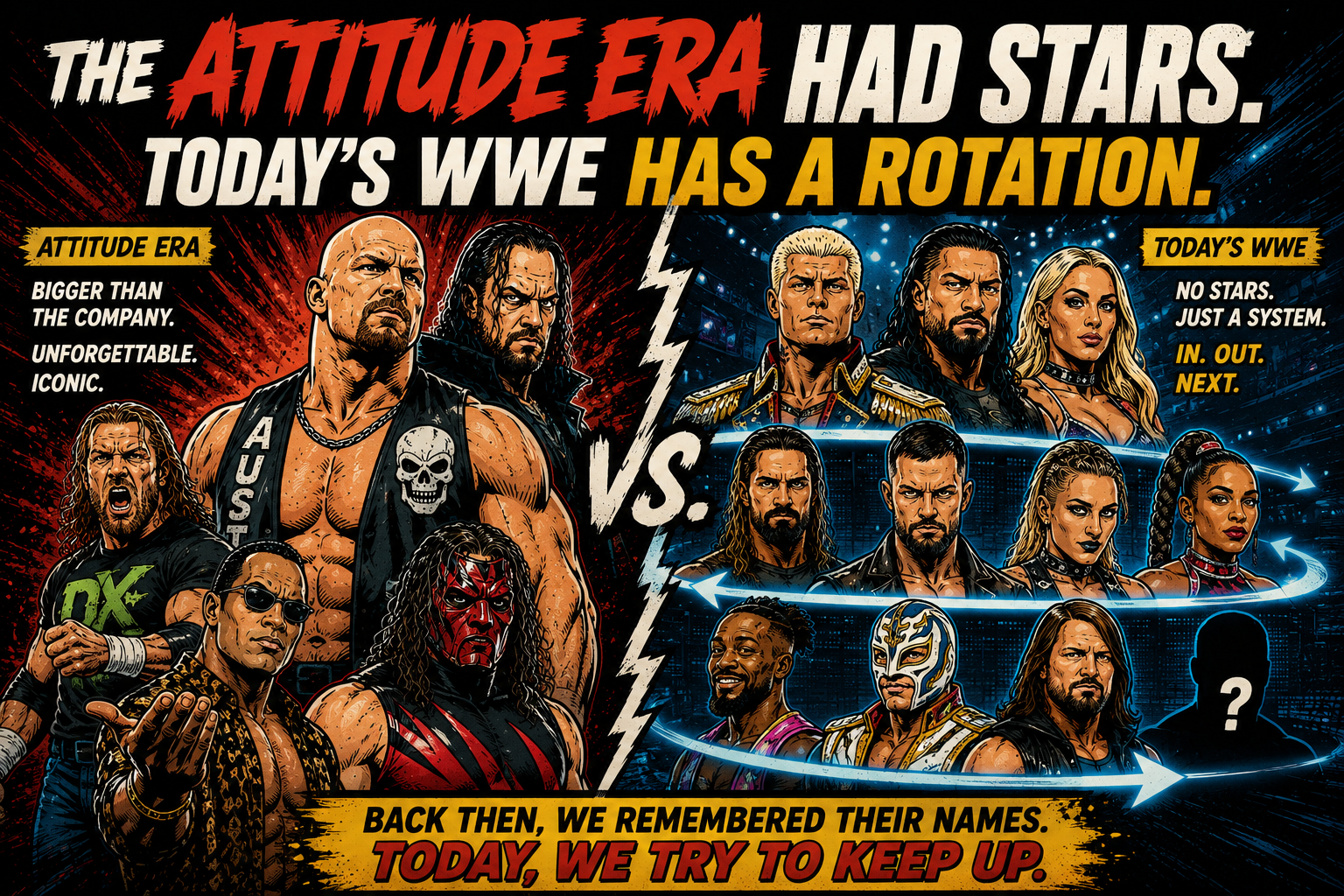
The Attitude Era Had Stars. Today’s WWE Has a Rotation.
The Attitude Era thrived because championships felt attainable. While WWE had its top stars, almost anyone could rise to the occasion and win a title, creating genuine unpredictability. Today, most championships revolve around the same handful of performers, leaving much of the roster without a believable path to success. Has WWE traded suspense for stability?
What’s the verdict?
One of the biggest differences between WWE’s Attitude Era and today’s product isn’t the quality of the wrestling or even the storytelling. It’s the perception that championships actually mattered because nearly everyone on the roster had a believable chance to win one.
Yes, there were established main event stars. “Stone Cold” Steve Austin, The Rock, Triple H, The Undertaker, Mankind, and Kurt Angle were frequently in the World Championship picture. But they weren’t the only names who felt important.
The roster existed as a living ecosystem rather than a collection of separate tiers. One month, Kane could be World Champion. The next, Big Show. The Hardcore Championship bounced between dozens of competitors, making every backstage segment feel unpredictable. The Intercontinental and European Championships were launching pads instead of afterthoughts. Even the Tag Team Championship scene constantly evolved, creating fresh rivalries and giving fans a reason to care about teams beyond the top two.
Perhaps the best example was the WWF Championship itself. While Austin and The Rock defined the era, it wasn’t shocking when Mankind defeated The Rock on Raw. It wasn’t unbelievable when Big Show held the title. Even someone like JBL years later felt as though he had climbed into the main event through momentum rather than being artificially inserted into it.
That unpredictability is largely missing from today’s WWE.
Modern WWE often feels divided into two distinct groups: the chosen few and everyone else.
For each championship, fans can usually identify three or four wrestlers who have any realistic chance of holding that title over the next year. Everyone else exists to fill television time, lose meaningful matches, and occasionally challenge for a championship with little expectation that they’ll actually win.
When a title match is announced today, many fans don’t ask who will win. They ask how the champion will retain.
That’s a problem.
Professional wrestling is built on the illusion that anything can happen. If viewers already know who isn’t going to win, then half the roster immediately becomes irrelevant.
The issue isn’t that long title reigns exist. Some of the greatest championship reigns in history lasted years. The problem is when those reigns come at the expense of creating new credible contenders. Instead of elevating fresh stars, challengers often leave title programs feeling weaker than when they entered them because they were never presented as legitimate threats in the first place.
The Attitude Era constantly refreshed its roster hierarchy. Mid-card wrestlers could catch fire through memorable promos, crowd reactions, or simply being in the right storyline at the right time. Fans believed someone could get hot and ride that momentum all the way to championship gold.
Today, momentum often feels irrelevant.
A wrestler can become incredibly popular with the audience, produce outstanding matches, and sell merchandise, yet still spend months—or even years—waiting for an opportunity because the championship plans have already been mapped out around the same handful of names.
That predictability hurts everyone.
It hurts the championships because fewer people feel capable of winning them. It hurts the roster because talented performers become permanent supporting characters. And it hurts the audience because surprise has always been one of wrestling’s greatest strengths.
No one is arguing that every wrestler should become a world champion. That’s unrealistic. Every roster has stars who belong at the top.
But every roster should also have depth.
Fans should be able to look at fifteen or twenty wrestlers and honestly believe that, under the right circumstances, any one of them could capture a championship. That’s what made the Attitude Era feel alive. Every episode had the potential to create a new star, and every championship match carried genuine uncertainty.
WWE’s roster today is arguably the deepest it has ever been. The talent is there. The athleticism is there. The personalities are there.
Now the company simply needs to convince fans that the championships belong to the entire roster—not just a select few.
Add a Comment
Jump into the discussion. AI-seeded comments are clearly labeled; reader comments are not.
Add a Comment
Jump into the discussion. AI-seeded comments are clearly labeled; reader comments are not.