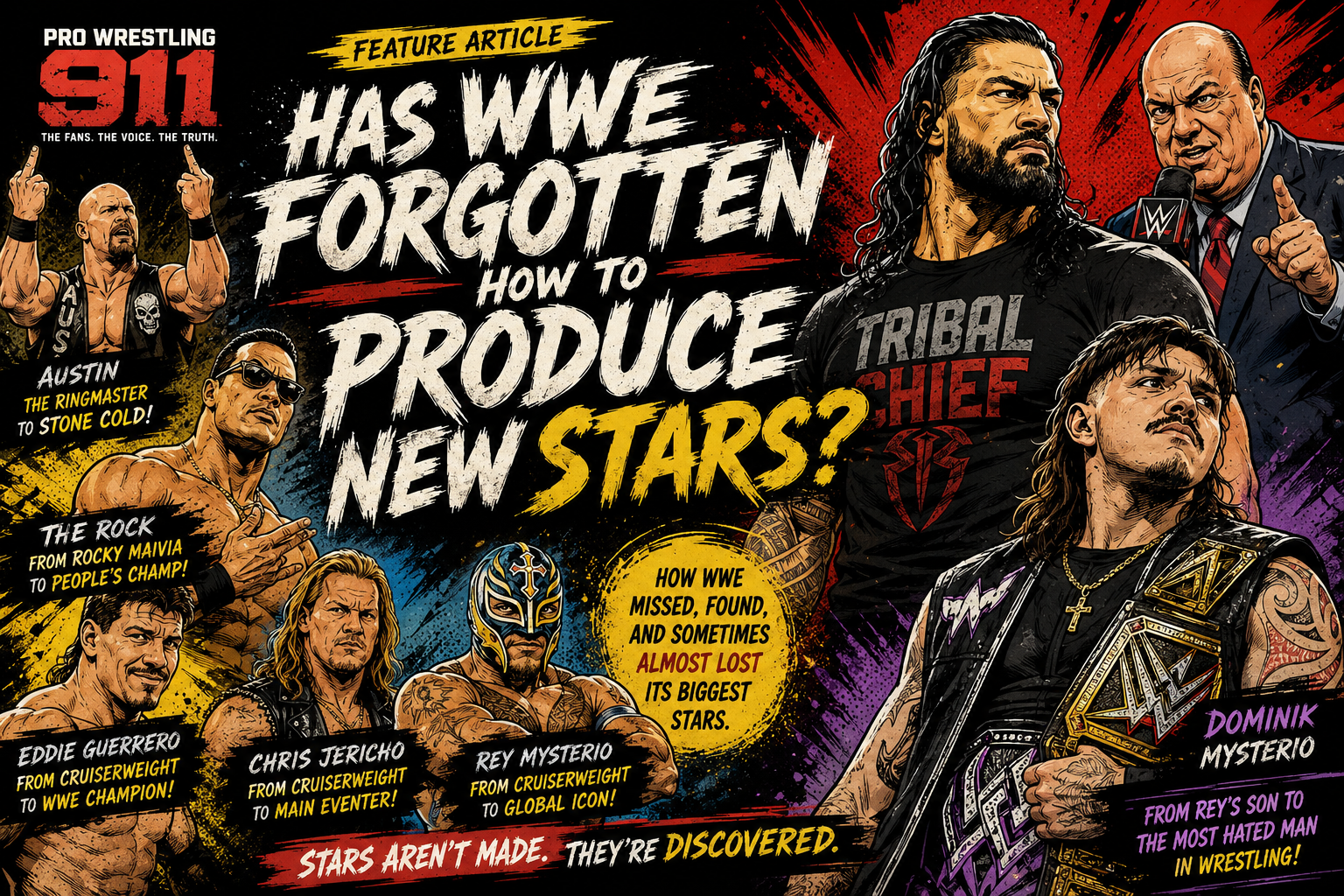
This article examines WWE’s complicated history of creating new stars, from nearly missing the potential of Steve Austin, The Rock and John Cena to giving former WCW cruiserweights like Eddie Guerrero, Chris Jericho and Rey Mysterio room to become main-event icons. Using Roman Reigns and Dominik Mysterio as modern examples, it argues that true stars aren’t manufactured by a formula—they emerge when WWE recognizes what makes a performer unique, gives them room to evolve, and knows when to get out of the way.
What’s the verdict?
Has WWE Forgotten How to Produce New Stars?
There was a time when WWE could take a wrestler and turn him into somebody your grandmother knew.
Hulk Hogan. “Stone Cold” Steve Austin. The Rock. John Cena.
You didn’t have to watch wrestling to know who these people were. They didn’t simply become WWE Champions. They escaped the wrestling bubble entirely.
So where are those people now?
Before somebody starts screaming Cody Rhodes at their phone, yes, WWE has stars. Cody Rhodes is a star. Roman Reigns is a star. CM Punk is a star. But there is an important distinction between having stars and producing new ones.
And lately, WWE seems much better at the first than the second.
Maybe the strangest part is that this isn’t a new problem. WWE has nearly screwed up some of the biggest stars it ever created.
Steve Austin Was Almost Just “The Ringmaster”
Steve Austin walked into the WWF and they made him The Ringmaster.
Think about that for a second.
One of the most naturally charismatic, believable, anti-authority personalities professional wrestling has ever seen was standing right in front of them, and WWE’s initial answer was essentially:
“Here’s Ted DiBiase. You’re a wrestling technician now.”
The man who would eventually drink beer, flip off his boss and become the centerpiece of the biggest boom period in company history was introduced with a gimmick that had approximately as much personality as the instruction manual for a microwave.
Then something happened.
Steve Austin started becoming Steve Austin.
The Ringmaster disappeared. The shaved head stayed. The black trunks stayed. The attitude became real. The frustration became part of the presentation.
And eventually Austin was handed a microphone after winning the 1996 King of the Ring.
Austin 3:16 was born.
WWE didn’t invent Stone Cold Steve Austin.
For the most part, Steve Austin did.
And WWE was smart enough to eventually recognize what was happening and get out of his way.
“Die Rocky Die”
Then there was Rocky Maivia.
WWE certainly hoped you would love him.
He smiled. He had the colorful outfit. He had the famous wrestling family. He was the clean-cut babyface WWE had decided everybody was going to cheer.
There was only one problem.
Everybody hated him.
“Rocky sucks!”
“Die Rocky Die!”
Those weren’t subtle hints from the audience.
The fans were telling WWE, very loudly, that whatever this was supposed to be wasn’t working.
Eventually WWE stopped trying to convince fans that Rocky Maivia was lovable and allowed Dwayne Johnson to lean into something much closer to his natural charisma.
The smile became a smirk.
The humble babyface became an arrogant asshole.
Rocky Maivia started referring to himself in the third person, insulting practically everyone within microphone range and carrying himself like the most important human being who had ever entered the building.
And suddenly the guy fans couldn’t stand became The Rock.
Funny how that works.
The talent hadn’t suddenly appeared.
The charisma hadn’t magically developed overnight.
It had been there.
WWE just had to stop covering it up with the character it wanted him to play.
John Cena Was Almost Fired
Then there’s John Cena.
Cena debuted against Kurt Angle with the now-famous “ruthless aggression” moment.
Great introduction.
Then what?
Not much.
Cena wasn’t connecting. He wasn’t particularly memorable. And Cena himself has discussed reaching a point where he believed his WWE career was coming to an end.
The man who would eventually become the face of WWE for more than a decade was apparently approaching the unemployment line.
Then Stephanie McMahon heard him freestyle on a bus.
That’s it.
Not months of focus groups.
Not a brilliant master plan developed by creative.
Not someone sitting in an office saying, “You know what this company needs? A white rapper from Massachusetts.”
Cena demonstrated an actual piece of his personality, somebody important noticed it, and WWE put it on television.
The Doctor of Thuganomics was born.
And suddenly John Cena had something.
He could talk.
He could improvise.
He could insult people.
He could interact with the audience.
Most importantly, he was different from everybody else on the show.
That eventually evolved into John Cena—the man WWE would build around for more than a decade.
Three of the biggest stars WWE has ever produced share an interesting piece of history.
At one point, WWE didn’t seem to understand what it had.
The solution wasn’t necessarily giving them a better script.
It was getting the hell out of their way.
Sometimes the Problem Isn’t Creating a Star. It’s Putting a Ceiling on One.
There’s another way wrestling companies have managed to miss stars standing directly in front of them.
Sometimes they recognize the talent.
They just decide how far that talent is allowed to go.
WCW might be the greatest example of this in modern wrestling history.
Look at Eddie Guerrero.
Look at Chris Jericho.
Look at Rey Mysterio.
WCW certainly understood that these guys could wrestle. That’s why they were there. That’s why they were given television time. That’s why the cruiserweight division became one of the best parts of WCW programming.
But there was an invisible ceiling above them.
You’re a cruiserweight.
That’s your spot.
Go out there, have an incredible match, get the crowd excited—and when you’re finished, the “real” stars will take it from here.
Chris Jericho
Chris Jericho actually managed to show quite a bit of personality in WCW.
His increasingly unhinged heel character produced some hilarious television. The conspiracy victim. The ridiculous arrogance. The list of 1,004 holds. Ralphus.
Anyone paying attention could see there was considerably more to Chris Jericho than being another good wrestler under 225 pounds.
But future world champion?
The first Undisputed WWF Champion?
WrestleMania main-eventer?
A guy who would repeatedly reinvent himself over the next several decades?
WCW apparently didn’t see that Chris Jericho.
They saw a cruiserweight who could entertain people.
WWE saw someone who might eventually entertain them at the top of the card.
There’s a massive difference.
Eddie Guerrero
Eddie Guerrero may be an even better example.
The charisma was always there.
The facial expressions were there.
The ability was obviously there.
But Eddie Guerrero as WWE Champion?
Eddie Guerrero defeating Brock Lesnar for the WWE Championship?
Eddie standing inside Madison Square Garden at WrestleMania XX holding a world championship?
That would have sounded ridiculous if you’d suggested it during much of his WCW run.
Not because Eddie wasn’t capable of it.
Because the company had already decided what Eddie Guerrero was.
A cruiserweight.
WWE eventually discovered something WCW never fully exploited:
Eddie Guerrero wasn’t just an incredible wrestler.
Eddie Guerrero was a personality.
Lie.
Cheat.
Steal.
Suddenly Eddie wasn’t defined by what he weighed.
He was defined by what happened when he walked through the curtain.
Fans loved him.
They understood him.
They knew exactly what Eddie Guerrero was about.
And most importantly, they were emotionally invested in him.
That’s a star.
Rey Mysterio
Then there’s Rey Mysterio.
WCW had one of the most visually unique wrestlers professional wrestling had ever produced and, at one point, actually took his mask away.
Think about that decision.
Rey Mysterio would eventually become one of the most recognizable masked wrestlers on the planet.
Children would wear his masks to arenas.
His merchandise would be everywhere.
He would become WWE Champion.
World Heavyweight Champion.
Royal Rumble winner.
Hall of Famer.
One of the most recognizable professional wrestlers of his generation.
WCW looked at that guy and somehow concluded:
“You know what would improve this? Let’s take the mask off.”
Brilliant.
But there’s a larger lesson buried inside all three careers.
Sometimes creating a star doesn’t mean inventing something that isn’t there.
Sometimes it means removing the ceiling.
You Can’t Manufacture Charisma
Professional wrestling exists in a strange place between sport, theater and improvisation.
Yes, wrestlers are playing characters.
But the best wrestling characters usually contain something real.
Steve Austin wasn’t really driving a beer truck to work and giving his employer the middle finger every morning. But the attitude was believable because there was something genuine underneath it.
The Rock wasn’t actually a narcissistic lunatic who needed to tell everyone within a five-mile radius what he was cooking. But the confidence, timing and wit belonged to Dwayne Johnson.
John Cena wasn’t spending his evenings wandering around Massachusetts challenging random people to freestyle battles. But the ability to rap, improvise and interact with a crowd was actually his.
Eddie Guerrero probably wasn’t lying, cheating and stealing his way through every normal day of his life.
The character exaggerated something that was already there.
That’s different from handing somebody a character and saying:
Here. Pretend to be this.
Sometimes that works.
The Undertaker certainly wasn’t walking around funeral homes during the week before wrestling on Saturday night.
Bray Wyatt wasn’t actually the supernatural leader of a swamp cult.
Professional wrestling absolutely has room for performers playing characters.
Some wrestlers thrive on exactly that.
But that requires something else WWE occasionally seems to forget:
Not every performer needs the same creative process.
Some wrestlers need freedom.
Others desperately need structure.
And then there’s Roman Reigns.
The Roman Reigns Exception
Roman Reigns is almost the reverse example.
If Vince McMahon could have assembled his ideal WWE Superstar in a laboratory, there’s a pretty good chance Roman Reigns would have climbed out of the machine.
Tall.
Built like a superhero.
Good-looking.
Athletic.
Legitimate wrestling lineage.
The guy looked like somebody Vince McMahon would have wet dreams about.
Then somebody handed Roman a microphone.
And Vince probably shriveled up like he’d just survived falling through the ice on a lake.
For years WWE tried to convince audiences that Roman Reigns was the guy.
Not a guy.
THE guy.
The problem wasn’t Roman’s wrestling ability.
Put him in the ring with the right opponent and Roman could absolutely deliver.
The problem was everything surrounding it.
The scripted promos.
The forced catchphrases.
The unnatural attempts at comedy.
The constant feeling that WWE wasn’t asking the audience whether they liked Roman Reigns—it was informing them that they did.
The harder WWE pushed, the harder portions of the audience pushed back.
And listening to Roman trying to deliver some of those promos could make matching socks seem like a pretty exciting way to spend an evening.
Then Paul Heyman entered the equation.
And everything changed.
Roman didn’t suddenly learn how to wrestle.
He didn’t suddenly become six inches taller.
He didn’t suddenly discover charisma buried underneath Titan Towers.
The presentation changed.
The Tribal Chief wasn’t Roman desperately trying to convince everyone he was cool.
He didn’t need your approval anymore.
He demanded acknowledgment.
And Paul Heyman filled the spaces Roman couldn’t.
Heyman could talk.
Heyman could sell the importance of Roman Reigns without Roman having to spend ten minutes explaining his own greatness.
Heyman could stand behind him with that expression on his face and somehow make Roman seem more important without saying a single word.
He gave Roman’s character an atmosphere.
And Roman became exponentially more interesting.
That’s good creative.
Not because WWE created another Steve Austin.
Because WWE finally recognized that Roman Reigns wasn’t Steve Austin.
That’s the entire point.
Which Brings Us to Dominik Mysterio
If you want a modern example of why wrestlers need room to evolve, forget Austin.
Forget Rock.
Forget Cena.
Look at Dominik Mysterio.
Because when Dominik first arrived alongside his father, I wouldn’t have predicted any of this.
Let’s be fair.
He was boring.
Not terrible.
Not hopeless.
Just boring.
Watching Dominik Mysterio during those early years was about as exciting as watching paint dry—and at least with paint you eventually get to touch it to see whether it’s finished.
He was Rey Mysterio’s kid.
That was basically the character.
He could wrestle.
He was young.
He had potential.
And he had one enormous problem:
His father was Rey freaking Mysterio.
How do you develop your own identity while standing beside one of the most beloved wrestlers of all time?
You don’t.
Eventually, you punch him.
And that’s when something remarkable happened.
Dominik was allowed to evolve.
The clean-cut kid disappeared.
Then came Judgment Day.
Then came “Prison Dom.”
Then the ridiculous stories about his hardened criminal past after spending approximately enough time in jail to finish a large pizza.
The mullet.
The mustache.
The arrogance.
The facial expressions.
The women.
The constant disrespect toward his father.
Every piece made him slightly more obnoxious.
And crowds absolutely hated him.
There were nights when Dominik could barely speak because audiences were booing so loudly.
Think about how difficult that is.
Wrestling audiences today know the show is a show.
They know Dominik isn’t actually the world’s most hardened ex-convict.
They know Rey Mysterio probably isn’t sitting backstage wondering where he went wrong as a father.
And they boo Dominik anyway.
That’s not failure.
That’s charisma.
Listen Closely to Those Boos
There’s something else happening with Dominik, though.
And WWE needs to pay very close attention to it.
Because wrestling history has demonstrated something repeatedly:
If you’re entertaining enough for long enough, eventually people start liking you.
It happened with The Rock.
It happened with Steve Austin.
It has happened with countless heels who became so entertaining that fans eventually stopped participating the way the storyline instructed them to.
You can tell an audience whom they’re supposed to hate.
You cannot make them hate somebody forever.
Eventually, hard work overcomes the storyline.
And I think Dominik Mysterio has the potential to reach that point.
Maybe not tomorrow.
Maybe not next year.
But imagine WWE actually commits to this for another couple of years.
Dominik continues improving in the ring.
He continues developing on the microphone.
He gradually becomes less dependent on everyone surrounding him.
The boos slowly become mixed reactions.
Then one night something happens.
Someone turns on him.
Someone screws him.
Or Dominik finally finds himself standing opposite somebody the audience hates even more than they supposedly hate him.
And suddenly those boos aren’t boos anymore.
WrestleMania 2028
Now imagine WrestleMania.
Hopefully WrestleMania 2028 in Nashville, because selfishly, I’d like to be sitting in the building when it happens.
Dominik Mysterio is challenging for the WWE Championship.
I don’t care who the champion is.
I don’t care whether Dominik wins clean, survives an absolute war or pulls one last trick out of the Eddie Guerrero playbook.
1…
2…
Dominik Mysterio is WWE Champion.
If WWE handles his evolution correctly between now and then, I genuinely believe the reaction could be one of the loudest pops WWE has heard in years.
Because the audience wouldn’t merely be celebrating a championship victory.
They’d be celebrating the journey.
They would remember the awkward kid standing beside Rey.
They would remember the heel turn.
They would remember Prison Dom.
They would remember booing him so loudly that he couldn’t get through a promo.
They would remember watching him get better.
They would remember the moment when they realized they weren’t booing because they wanted Dominik to go away anymore.
They were booing because booing Dominik Mysterio was part of the fun.
And eventually they would remember the moment when they stopped booing altogether.
Then comes Monday Night Raw.
Dominik walks through that curtain carrying the WWE Championship.
No Judgment Day.
No one talking for him.
No gimmick necessary.
Just Dominik Mysterio standing in the ring with the championship while the audience that once wouldn’t allow him to speak because they hated him so much refuses to let him speak for an entirely different reason.
“YOU DESERVE IT!”
“YOU DESERVE IT!”
“YOU DESERVE IT!”
Five minutes.
Maybe longer.
And here’s the incredible part:
That wouldn’t be WWE manufacturing a star.
It would be WWE doing exactly what it should have done all along.
Giving a talented performer enough time, opportunity and freedom to discover what he could become.
Stop Looking for the Formula
And maybe this is WWE’s biggest problem when attempting to create the next generation of stars.
There isn’t a formula.
You can’t take Roman Reigns’ presentation, change the entrance music, insert another wrestler and manufacture Roman Reigns 2.0.
You can’t find someone who can rap and manufacture another John Cena.
You can’t put sunglasses on an angry bald guy and manufacture another Steve Austin.
And God knows how many wrestlers have tried raising one eyebrow since 1998.
Stars become stars because something distinguishes them from everybody else.
The job of a wrestling promotion isn’t necessarily to create that distinction.
Sometimes its job is simply to recognize it.
That means letting wrestlers fail occasionally.
Let them talk.
Let them experiment.
Let them discover what connects.
And when something doesn’t work, don’t immediately decide the wrestler doesn’t work.
Maybe the presentation doesn’t work.
Rocky Maivia didn’t work.
The Rock certainly did.
The Ringmaster didn’t work.
Stone Cold Steve Austin certainly did.
Early John Cena didn’t work.
The Doctor of Thuganomics changed everything.
Babyface Roman Reigns didn’t work the way WWE desperately wanted him to.
The Tribal Chief became the defining run of his career.
Rey Mysterio’s boring kid didn’t work.
Dirty Dom became one of the most entertaining performers in the company.
Same human beings.
Different presentation.
That’s not a coincidence.
Pay Attention When the Audience Tells You Something
This may be the most important part of producing stars.
Listen.
Fans told WWE Rocky Maivia wasn’t working.
Eventually WWE listened.
Austin knew The Ringmaster wasn’t working.
Eventually that disappeared.
John Cena was going nowhere until WWE discovered something he could do that actually separated him from everyone else.
Roman Reigns spent years receiving a reaction WWE didn’t want until his presentation was finally rebuilt around something audiences could believe.
And Dominik Mysterio started receiving reactions so enormous that WWE would have been insane not to lean into them.
Those aren’t exceptions to the star-making process.
That is the star-making process.
The audience is telling you who matters.
Sometimes they’re cheering.
Sometimes they’re booing.
Sometimes they’re chanting something you absolutely did not want them to chant.
It doesn’t matter.
The dangerous reaction isn’t hatred.
It’s silence.
If 15,000 people are willing to scream at somebody every time he opens his mouth, you’ve got something.
Figure out what it is.
Where Is the Next One?
This is where WWE should be concerned.
The roster isn’t short on talent.
If anything, WWE may have one of the deepest collections of physically gifted performers it has ever had.
There are wrestlers who can have incredible matches seemingly on command.
There are men and women who look like they were genetically engineered to appear on WrestleMania posters.
There are athletes in developmental who can do things that would have been considered impossible twenty years ago.
But being an incredible professional wrestler and being a star aren’t the same thing.
Stars make you stop changing channels.
Stars make you buy tickets when you don’t even know the rest of the card.
Stars make children want their T-shirt.
Stars make adults argue about them at work the next morning.
And the truly special ones make people who don’t even watch wrestling know their names.
That’s the standard.
And that’s why WWE doesn’t need another Steve Austin.
It doesn’t need another Rock.
It doesn’t need another John Cena.
It doesn’t need another Eddie Guerrero.
It doesn’t need another Rey Mysterio.
And it certainly doesn’t need another Roman Reigns.
It needs to identify whatever is sitting on its roster right now that we’ve never seen before.
Maybe it’s Oba Femi.
Maybe it’s Bron Breakker.
Maybe it’s Dominik Mysterio.
Maybe it’s somebody currently wrestling five-minute matches that nobody inside creative realizes is sitting on something special.
History suggests that’s entirely possible.
Because WWE’s greatest star-making ability has occasionally been preceded by its greatest weakness:
They almost didn’t recognize the star standing directly in front of them.
And WCW demonstrated the alternative.
Eddie Guerrero was once just a cruiserweight.
Chris Jericho was once just a cruiserweight.
Rey Mysterio was once just a cruiserweight.
WCW saw the division.
WWE eventually saw the wrestler.
Steve Austin was once The Ringmaster.
Rocky Maivia was once being told to die by the audience.
John Cena was once waiting to be fired.
Roman Reigns was once the guy WWE desperately wanted everyone to love while huge portions of the audience desperately wanted WWE to stop telling them to love him.
Dominik Mysterio was once Rey’s boring kid.
Professional wrestling history is filled with people who became something nobody expected.
And maybe that’s the answer to the original question.
Has WWE forgotten how to produce new stars?
Maybe.
But perhaps the bigger problem is the assumption that stars are something a wrestling company can simply produce.
You can produce television.
You can produce an entrance.
You can produce a storyline.
You can produce a championship match.
You can spend millions of dollars producing WrestleMania.
But you can’t sit in a creative meeting and manufacture whatever it was that made Steve Austin connect with millions of people.
You can’t write charisma into a script.
You can’t assign someone The Rock’s timing.
You can’t teach an audience to care.
What WWE can do is create the environment where those things have an opportunity to emerge.
Give wrestlers opportunities.
Give them time.
Give them direction when they need it.
Give them Paul Heyman when they really need it.
And when they start becoming something bigger than whatever you originally planned for them?
Pay attention.
WCW probably would have looked at Dominik Mysterio and seen another cruiserweight.
Early WWE looked at him and saw Rey Mysterio’s son.
Judgment Day saw an obnoxious little shit everyone wanted to punch.
Maybe none of those things are what Dominik Mysterio ultimately becomes.
Maybe we’re watching the middle of the story.
That’s why WWE shouldn’t decide the ending too soon.
Because the companies that produce genuine stars aren’t necessarily the companies capable of predicting exactly what every wrestler will become.
They’re the companies smart enough to recognize when a wrestler is becoming something bigger than they originally planned.
Then they turn up the volume.
Remove the ceiling.
And most importantly—
they know when to get the hell out of the way.
Add a Comment
Jump into the discussion. AI-seeded comments are clearly labeled; reader comments are not.
Add a Comment
Jump into the discussion. AI-seeded comments are clearly labeled; reader comments are not.