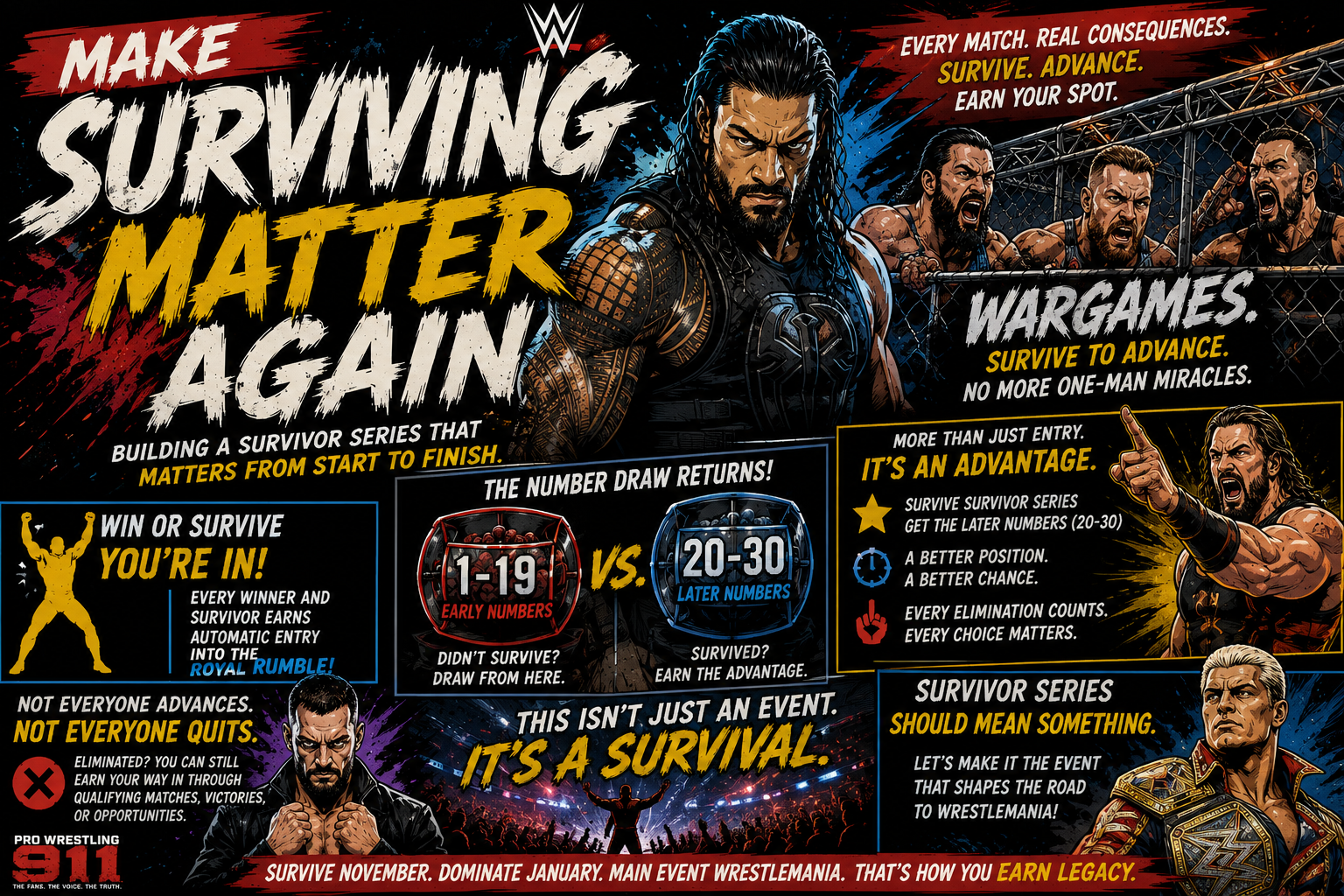
Survivor Series has become too predictable, with WWE building toward WarGames every November simply because the calendar says it’s time. This article proposes giving the entire event real consequences: winners and survivors automatically qualify for the Royal Rumble and earn the right to draw from the coveted later entry numbers. By connecting Survivor Series directly to the Royal Rumble and WrestleMania season, WWE could make every match, elimination and victory matter again.
What’s the verdict?
Every year, somewhere around October or November, something strange begins happening in WWE.
Wrestlers suddenly become obsessed with friendship.
People who have spent the previous six months trying to kill each other start discussing teamwork.
Groups begin forming.
Someone inevitably announces that they need one more person.
And everybody watching at home already knows who that person is going to be.
Why?
Because it’s November.
And apparently November in WWE means we must begin assembling WarGames teams.
That’s become one of my biggest problems with Survivor Series.
It’s predictable.
Not necessarily the outcome of every match, but the structure surrounding the event.
We know WarGames is coming.
We know teams are coming.
We know somebody is going to need one final partner.
We know that final partner will probably be whoever has an existing problem with somebody on the opposing team.
Eventually somebody dramatically says:
“There’s only one person I know who can help us.”
Cue music.
Crowd goes crazy.
Everybody acts surprised.
Except nobody is surprised.
We’ve seen this movie before.
So instead of spending another year trying to figure out which collection of wrestlers can be shoved into WarGames because the calendar says it’s time, I’d rather fix something much bigger.
Make the entire Survivor Series card matter again.
Survivor Series Used to Have an Identity
Survivor Series was built around a very simple concept.
Survival.
Teams competed in elimination matches.
Get pinned, you’re gone.
Get submitted, you’re gone.
The match continues.
And when it ends, whoever is left standing is the survivor.
Sometimes there were several survivors.
Sometimes there was one.
Sometimes an entire team got wiped while the entire other team survived.
That’s what made the format interesting.
The problem is that somewhere along the way, Survivor Series became less about surviving and more about whatever WWE happens to be doing in November.
For years we had Raw versus SmackDown.
Suddenly wrestlers who had spent the entire year trying to destroy each other developed tremendous loyalty to whichever television show their name happened to appear on.
Then we’d get the obligatory red shirts.
The blue shirts.
People yelling about brand supremacy.
And then, after Survivor Series ended, most of them stopped caring approximately five minutes later.
Now WarGames has become the centerpiece.
I love WarGames.
That’s not the problem.
The problem is when the existence of WarGames begins dictating the stories instead of the stories creating a need for WarGames.
If ten people have reached a point where putting them inside two rings surrounded by a steel cage makes sense, great.
Do it.
But don’t spend October manufacturing reasons for ten people to hate each other because somebody already printed WARGAMES on the November poster.
There’s a difference.
So let’s give Survivor Series an identity again.
And let’s start with the name.
Survivor.
If You Survive, You Advance
Here’s the concept.
Every match at Survivor Series matters because every winner—or survivor—earns something.
Automatic entry into the Royal Rumble.
That’s it.
Simple.
You win at Survivor Series, you’re in the Royal Rumble.
No qualifying match required.
No begging Adam Pearce for an opportunity.
No announcement that you have “officially declared” for the Royal Rumble even though apparently anyone can do that.
You survived Survivor Series.
You’ve earned your spot.
Singles match?
Winner advances.
Triple threat? Single elimination. Winner advances.
Fatal four-way? Single elimination. Winner advances.
Traditional Survivor Series elimination match?
Every wrestler still standing on one team when the match ends advances.
WarGames?
Same principle.
Survivors advance.
Now suddenly everything on the card has consequences.
Bring Back Elimination Matches
This also gives WWE a reason to bring traditional Survivor Series matches back without forcing them into meaningless Raw versus SmackDown situations.
You don’t need brand supremacy.
You need stakes.
Put together teams based on actual storylines.
Four-on-four.
Five-on-five.
Whatever makes sense.
But here’s the important part:
It’s single elimination.
If you get pinned, you’re done.
And if your team eventually wins after you’ve already been eliminated?
Congratulations to your teammates.
You’re still not automatically going to the Royal Rumble.
You didn’t survive.
That’s the entire point.
Imagine what that does to the psychology of the match.
Suddenly getting eliminated matters.
A wrestler isn’t simply walking backstage because his portion of the match is finished.
He just lost guaranteed entry into the Royal Rumble.
Now teammates have competing motivations.
Do I sacrifice myself to save my partner?
Do I break up that pin?
Do I tag somebody else because I don’t want to risk elimination?
Do I abandon my team because I’ve decided surviving is more important than winning?
There’s an entire layer of storytelling WWE gets practically for free.
And Please Stop Doing the One-Man Comeback Every Time
There’s another thing.
Don’t make these matches predictable.
We’ve seen the formula.
One team dominates.
Eventually there’s one wrestler left on the other side.
He’s standing there alone against three or four opponents.
Surely it’s impossible.
And then…
Superman arrives.
One elimination.
Two eliminations.
Three eliminations.
And somehow the guy who couldn’t beat one of these wrestlers ten minutes ago has now beaten the entire team by himself.
That can be an incredible story.
Occasionally.
But if you keep doing it, it’s no longer an incredible comeback.
It’s just the formula.
Sometimes the final score should be 3-0.
Sometimes two people should survive.
Sometimes four people should survive.
Sometimes the last remaining member of a team should fight like hell…
and lose.
That’s sports.
That’s competition.
And unpredictability is what makes elimination matches work.
If I genuinely don’t know how many people will survive, suddenly every pin attempt matters.
WarGames Shouldn’t Be Exempt
This concept should extend to WarGames.
And yes, I understand WarGames isn’t traditionally an elimination match.
Change it.
For Survivor Series, make it elimination.
If you’re pinned or submitted, you’re gone.
Now imagine what that does to WarGames.
Someone enters the Royal Rumble conversation simply by surviving.
Someone else loses their automatic Royal Rumble spot because they got eliminated thirty seconds before their team won.
Maybe somebody deliberately refuses to help a teammate because they’re protecting their own Rumble position.
Maybe a heel realizes he’s the last remaining member of his team and spends several minutes desperately trying to escape three opponents.
Maybe somebody sacrifices their own Royal Rumble opportunity to save a teammate.
Those aren’t random wrestling spots.
Those are stories.
And that’s what the stipulation should create.
But Losing Doesn’t Mean You’re Out of the Royal Rumble
This is important.
Getting eliminated at Survivor Series does not mean you cannot compete in the Royal Rumble.
That would create too many booking problems.
It means you aren’t automatically entered.
The survivors have qualified.
Everybody else still has work to do.
Maybe there are qualifying matches on Raw and SmackDown.
Maybe somebody earns entry through another tournament.
Maybe a general manager awards a spot based on performance.
Maybe somebody gets in because another wrestler is injured.
Whatever.
The point is that Survivor Series gives wrestlers the first—and best—opportunity to secure their place.
But I’d take it one step further.
Because simply getting into the Royal Rumble isn’t enough.
Survive Survivor Series and You Get the Good Numbers
Now we’re talking.
Anyone who survives Survivor Series doesn’t merely earn Royal Rumble entry.
They earn access to the later entry numbers.
Let’s say 20 through 30.
Everyone else?
Numbers 1 through 19.
Suddenly Survivor Series becomes enormously important.
Because entering the Royal Rumble at number 27 instead of number 7 is a legitimate competitive advantage.
And WWE doesn’t even have to pretend otherwise.
Make that part of the story.
Survive in November and you’ve earned an easier road in January.
Get eliminated?
You can still reach the Royal Rumble.
But you’re going to have to work harder when you get there.
That’s consequence.
That’s continuity.
That’s one PLE affecting another PLE.
That’s something WWE desperately needs more of.
Bring Back the Royal Rumble Number Draw
And while we’re fixing things…
Bring back the damn number draw.
Remember when wrestlers actually picked their Royal Rumble numbers?
We’d see the tumbler backstage throughout the night.
People would draw numbers.
Somebody would look devastated.
Somebody else would start celebrating.
Someone would refuse to show anybody what they drew.
Eddie Guerrero would probably steal somebody else’s number.
Those little segments made the Royal Rumble feel like an actual event rather than thirty entrance themes WWE arranged ahead of time.
Bring it back.
Except now we have two tumblers.
One contains numbers 1 through 19.
The other contains numbers 20 through 30.
If you survived Survivor Series?
You draw from the second tumbler.
You earned it.
Everyone else draws from the first.
And don’t rig every important person’s number for storyline convenience.
Actually make the draw feel random.
Sometimes your biggest star gets number 4.
Sometimes somebody unexpected gets 29.
Sometimes the guy everyone assumes is winning pulls number 11 and suddenly the entire conversation changes.
The Royal Rumble is inherently based on randomness.
Let it feel random.
And If the Royal Rumble Becomes Two Nights…
This idea becomes even more useful if WWE eventually makes the Royal Rumble a two-night event.
You can apply the same concept to both Rumbles.
Men.
Women.
Survivor Series survivors earn their advantages.
Everybody else has to qualify and draw from the earlier pool.
Now Survivor Series isn’t merely setting up one Royal Rumble.
It’s establishing the competitive landscape for the entire beginning of WrestleMania season.
November matters to January.
January determines WrestleMania.
Now we have progression.
Survivor Series → Royal Rumble → WrestleMania.
Each event affects the next.
That’s how a wrestling calendar should work.
Give Every Match a Purpose
And this is really the larger point.
Not every match at a PLE needs to conclude a six-month blood feud.
Sometimes two people can wrestle because winning matters.
Professional wrestling has become so dependent on personal feuds that we occasionally forget the easiest reason imaginable for two wrestlers to have a match:
They both want something.
You don’t need somebody to insult somebody’s family.
You don’t need someone to steal a championship belt.
You don’t need somebody to interrupt somebody else’s promo for four consecutive weeks.
Sometimes the story can simply be:
If I beat you, I’m going to the Royal Rumble.
That’s enough.
Now even the third match on the Survivor Series card has stakes.
Maybe there isn’t some enormous storyline behind it.
Who cares?
The winner gets a guaranteed Royal Rumble spot and access to numbers 20 through 30.
I understand why they’re fighting.
I understand what winning means.
And I understand what losing costs.
That’s storytelling.
Stop Building Survivor Series Because It’s November
This is ultimately what I want WWE to get away from.
“Oh, it’s November. Better start figuring out WarGames.”
No.
If a storyline naturally leads to WarGames, give me WarGames.
If it doesn’t, don’t.
The match should exist because the story demands it.
The story shouldn’t exist because the match has already been scheduled.
And Survivor Series should be bigger than one or two WarGames matches anyway.
It’s one of WWE’s oldest major events.
The name itself gives you the entire concept.
Survive.
That’s all WWE needs.
You survive your match, you advance.
You survive an elimination match, you advance.
You survive WarGames, you advance.
And the better you perform at Survivor Series, the better your position becomes at the Royal Rumble.
Suddenly every match matters.
Every elimination matters.
Every save matters.
Every pinfall matters.
And most importantly, surviving matters.
That’s how you make Survivor Series important again.
Not by asking which five wrestlers can wear matching shirts this November.
Not by spending six weeks pretending we don’t know who the mystery fifth partner will be.
Not by manufacturing a WarGames feud because the calendar says it’s time.
Give the show consequences.
Give winning value.
Give losing a cost.
Connect Survivor Series directly to the beginning of WrestleMania season.
And when November rolls around next year, instead of thinking:
“Oh, it’s time for WarGames again.”
Maybe we’ll actually be thinking:
“Who’s going to survive?”
Add a Comment
Jump into the discussion. AI-seeded comments are clearly labeled; reader comments are not.
Add a Comment
Jump into the discussion. AI-seeded comments are clearly labeled; reader comments are not.