Shawn Spears and the Reinvention WWE Never Finished
Shawn Spears does not need another reinvention. He needs the final evolution of everything he has already been. The audience connection of the Perfect 10, the violence of the Chairman and his natural ability as a cold, calculating technician can become one complete main-event character.
With an unmistakable look, the sound of a chair snapping shut, quiet and unsettling promos, a brutally efficient moveset and the Dragon Sleeper renamed The Perfect Submission, every part of his presentation would serve the same purpose. A renewed rivalry with Cody Rhodes could establish that identity before propelling Spears into the world championship picture.
Tye Dillinger was a number. The Chairman was a moment. This version of Shawn Spears could be the finished product.
What’s the verdict?
Shawn Spears and the Reinvention WWE Never Finished
How the Perfect 10 and the Chairman can become one complete main-event character
A gimmick can get a wrestler noticed. Evolution is what makes him matter.
Shawn Spears has spent much of his career standing one adjustment away from something larger. The Perfect 10 gave him a connection with the audience that could not be manufactured. The Chairman gave him an edge audiences had never seen from Tye Dillinger. Each identity revealed part of what Spears could become, yet neither was developed far enough to make him a lasting main-event star.
The answer is not another unrelated gimmick. Spears needs a character that gathers the best elements of his past and turns them into a single idea: a cold, calculated technician who studies opponents, finds the flaw they believe they have hidden and attacks it with brutal efficiency.
He carries a steel chair because nobody understands that weapon better. He speaks softly because he never needs to explain what he knows. He wins with a Dragon Sleeper called The Perfect Submission because his matches should end as the inevitable result of a plan.
Every detail must support that idea. The look, entrance, promo delivery, moveset and booking cannot function as separate decorations. Together, they can produce the evolution WWE never gave Tye Dillinger and AEW never completed with the Chairman.
The Perfect 10 and Its Ceiling
In NXT, Tye Dillinger found something that worked.
The Perfect 10 was simple, but simplicity was part of its strength. It gave the crowd an unmistakable gesture, an effortless chant and a role in every entrance. Inside NXT’s smaller and more intimate environment, that participation made Dillinger feel important before the bell rang.
The character lost much of that force on WWE’s main roster.
Dillinger was not given the sustained television time, meaningful rivalries or significant victories needed to establish himself with a broader audience. Booking was part of the failure, but the gimmick had also reached its natural ceiling.
Being a Perfect 10 supplied a chant without answering the questions a lasting character must answer. What did perfection mean beyond the gesture? What did Dillinger want, and what would he do when audience approval did not produce opportunity?
This is the difficulty with moving a gimmick from a concentrated fan base to mainstream television. A passionate NXT crowd can turn a gesture into a movement. On the main roster, the same idea may look one-dimensional unless the performer gains a deeper motivation.
Vince McMahon was heavily criticized for repackaging wrestlers after call-ups, often with good reason, but the instinct behind some of those changes was understandable. What succeeds in NXT does not automatically translate to a larger stage. Some characters need to expand before they move up.
The mistake was not recognizing that Tye Dillinger needed to change.
The mistake was failing to decide what he should become.
When the Chair Changed Everything
That evolution finally appeared after Spears left WWE.
At AEW’s Fyter Fest in 2019, he struck Cody Rhodes with a steel chair after Cody’s time-limit draw with Darby Allin. One violent moment erased the audience’s assumptions about the former Perfect 10.
The Chairman had arrived.
The attack worked because it carried years of frustration without requiring a long explanation. Spears had been treated as a dependable performer whose popularity was acknowledged but rarely rewarded. The chair shot made him look like a man who had stopped waiting for permission.
The smile and chant no longer mattered. He had discovered a colder identity capable of creating its own opportunities.
AEW built a strong rivalry around the attack, including Spears’ resentment after Cody described him as a “good hand.” Cody ultimately defeated Spears at All Out, and the Chairman never recovered the momentum of his arrival.
AEW found the right progression but did not follow it far enough.
For the second time in Spears’ career, a compelling identity appeared without receiving the sustained victories required to discover its ceiling.
A Look That Belongs to Shawn Spears
The next version of Spears must look like someone the audience has never seen.
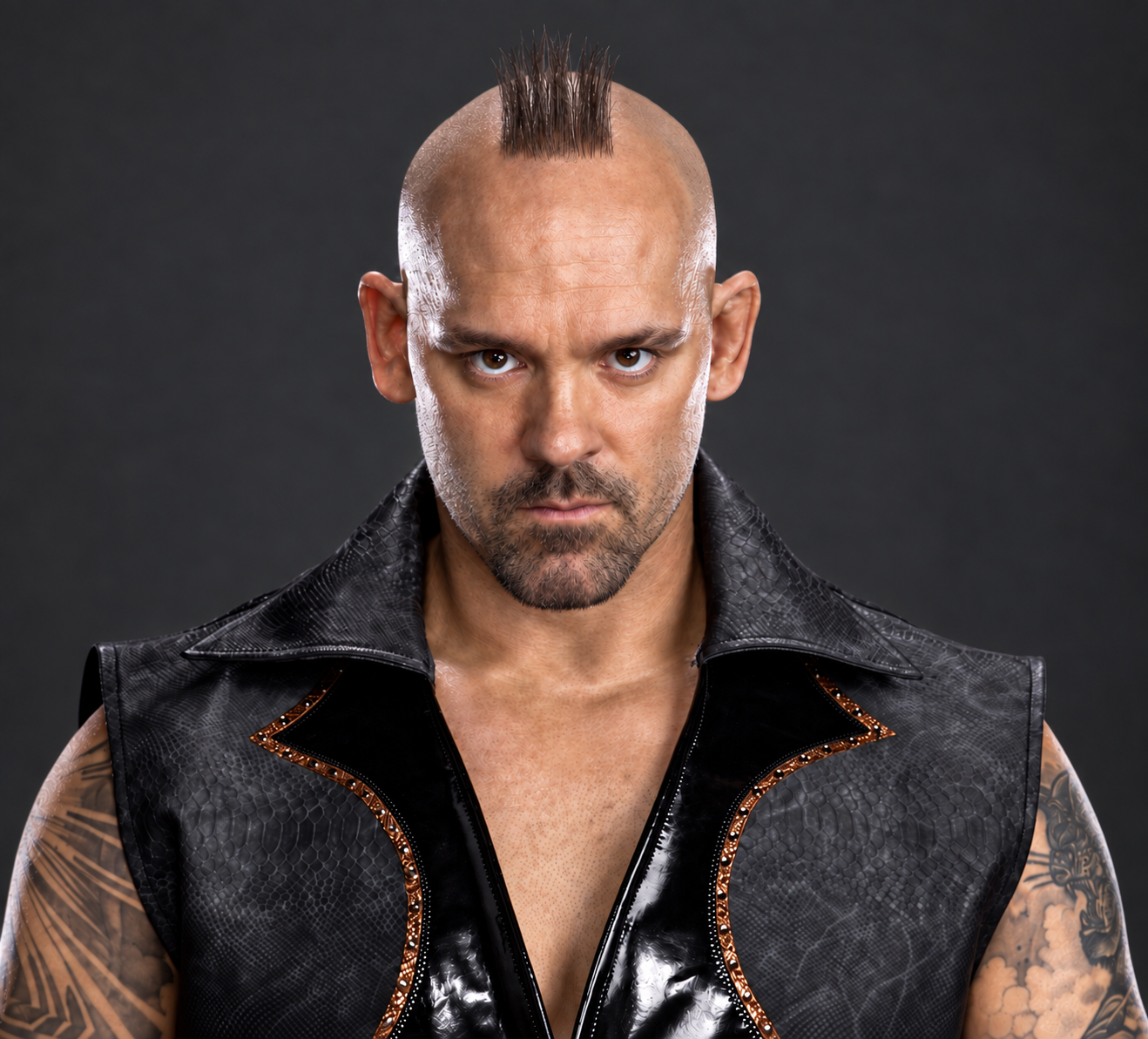
His mohawk and goatee make him recognizable, but they rely on familiar wrestling shorthand for an aggressive veteran. Returning to the braids from the Tye Dillinger era would be worse. Those braids belong to a previous identity, and this character should advance rather than reach backward.
Spears has the facial structure to carry a more unusual presentation. His sharp features, intense eyes and naturally severe expression should become the center of the design.
An intentional five-o’clock shadow would frame his jaw without returning to the carefully maintained goatee. It should look controlled but slightly rough—never like he simply chose not to shave.
The scalp would be shaved completely except for one isolated horizontal row of hair at the absolute front of the hairline. That row would measure roughly three to four inches across and stand about four inches straight upward, with no strip continuing toward the crown.
The result would create an immediate silhouette while avoiding the appearance of another thin mohawk.
The look works because it communicates the character before Spears says anything. It is precise, severe and unusual enough to register from any camera angle.
The Man Who Finds the Flaw
The Perfect 10 asked the audience to judge him. The Chairman forced the audience to pay attention.
This version of Shawn Spears would quietly pass judgment on everyone else.
His character rests on one private conviction: every wrestler has a flaw.
It could be a damaged shoulder, a predictable counter or a moment of hesitation buried beneath years of confidence. Spears studies matches until he finds it, then keeps that information to himself. Announcing the weakness would only give an opponent time to protect it.
Spears would offer little more than a stare or the suggestion that he already knows how the match will end. His strategy would emerge through action.
A wrench of the neck, a knee between the shoulder blades or an arm pulled backward might look insignificant early. As the match continues, those isolated attacks form a pattern. By the time the audience understands what Spears has targeted, the damage is already done.
This approach turns his technical skill into character.
He does not apply holds to demonstrate how many he knows. Each movement serves the plan. Every counter feels prepared. The opponent becomes a problem to solve, and The Perfect Submission becomes the final step in an argument Spears has been making since the opening bell.
His confidence also creates the flaw that keeps him human.
Spears trusts his analysis so completely that he struggles when the opponent adapts. If the expected weakness fails to appear, he tries to force the match back into the pattern he predicted. His movements grow sharper, his patience slips and the controlled technician gives way to frustration.
A wrestler devoted to finding imperfections in others becomes most vulnerable when he refuses to admit one of his own.
Recognizable in One Second
A great entrance theme identifies a wrestler before the music has time to develop.
The breaking glass for Steve Austin remains the clearest example. The sound hits, the crowd rises and the reaction begins before the first musical phrase. Spears needs that same instant recognition without borrowing Austin’s cue or relying on a spoken name.
That need is especially clear in WWE’s current musical environment. Describing Def Rebel’s work as a disaster would not be an overstatement. Too many themes require a wrestler’s name, a spoken catchphrase or another painfully literal introduction because the music itself fails to establish an identity.
Spears should avoid that problem entirely.
His entrance would begin with the amplified sound of a steel chair being slammed shut.
The violent metal-on-metal crack would cut through the arena, sharper and more distinct than the muffled sound of a chair striking someone. With consistent presentation, that one sound would become inseparable from Spears.
The music that follows would contain no words.
A low guitar would establish a slow melody before heavy drums join underneath it. The mood should carry the patient swagger of the instrumental passages in Bon Jovi’s “Blaze of Glory” or Fozzy’s “Judas” without imitating either song. It would build deliberately and move at the same pace as Spears.
He would appear in a simple open black hoodie with the hood pulled over his head. A folded chair would hang from one hand.
Spears would carry it casually rather than lift it for the crowd. His walk would have confidence without cockiness. He would not shout into the camera, perform a pose on the stage or acknowledge the audience. His attention would stay fixed on the ring and the opponent waiting inside it.
Once inside, Spears would walk to the center and stop with the chair at his side. The camera would move close enough to show only the shadow under the hood and the intensity of his eyes.
He would slowly pull the hood back.
The shot would hold on his stare before widening to reveal the five-o’clock shadow, the shaved scalp and the upright row of hair at the front.
There would be no smile and no Perfect 10 gesture.
The opening crack announces him. The music establishes his patience. The chair displays his expertise. The stare reveals his certainty.
The match has already begun in his mind before the bell rings.
The Quietest Man in the Room
Jake “The Snake” Roberts understood that volume does not create intensity.
He often lowered his voice while other wrestlers shouted, forcing the audience to lean closer and listen. Roberts summarized that philosophy in a line that should guide every Spears promo:
“If a man has enough power, he can speak softly and everyone will listen.”
— Jake Roberts
Randy Orton has used a similar patience at his best, speaking like a man who has already chosen what he will do and is giving his victim time to understand it.
Spears could push that restraint even further by treating every word as information—and information as something too valuable to waste.
Most wrestling promos provide answers. The wrestler explains why he is angry, what he plans to do and how he expects to win. Spears would withhold those answers.
His promos would be brief, deliberate and almost uncomfortably quiet. He would stand still, maintain eye contact and let silence imply that he knows more than he will reveal.
He would never name the weakness he found. Instead, he would speak around it:
“Everyone else watches what you do well. That is why they lose. I watched what happens immediately afterward.”
The opponent would spend the following days wondering which move Spears meant and whether a trusted strength had quietly become a liability.
Even his mannerisms would remain restrained. A slight lean, a narrowed gaze or the smallest trace of satisfaction would replace theatrical gestures. Then he would stop talking.
The rare moment when his voice rises would matter because it signals that the plan has failed and anger is replacing certainty.
Roberts made people listen. Orton made people anticipate violence.
Spears would make people wonder what he had already discovered.
The Perfect Submission
A finishing move should reveal something about the wrestler using it.
Spears delivers the Death Valley Driver well, but the move does not fully express the precision, timing and control at the center of this character. It should remain a powerful signature move and credible near fall rather than the definitive finish.
The easy reference would be to borrow the PerfectPlex, the bridging fisherman’s suplex made famous by Mr. Perfect Curt Hennig.
To be clear, the PerfectPlex has never been Spears’ move. The name would connect neatly to his former persona, but using it would build his evolution around another wrestler’s identity.
Spears needs something unmistakably his own.
The better answer is The Perfect Submission, a Dragon Sleeper that Spears can apply from almost any position.
He has the size and upper-body strength to make the hold look inescapable, while the mechanics display his technical intelligence. Once Spears traps the head, draws the opponent backward and locks his hands, the match shifts from impact to survival.
Its versatility creates danger before the hold is applied. Spears could take the back after a takedown, catch the opponent during a counter or move directly from an inverted facelock into the submission.
Each time he circles behind an opponent or reaches for the head, the audience would recognize the possibility.
The name carries the final connection to his past. The Perfect 10 depended on the audience’s approval. The Perfect Submission turns that obsession into control.
Perfection is no longer a chant.
It is the moment the opponent has nowhere left to go.
Nothing Without Purpose
Spears should never perform a move simply because it looks impressive.
There would be no unnecessary acrobatics, no elaborate sequence designed only to draw applause and no pause to admire his work.
His wrestling would be cold, calculated and brutally efficient.
The opening phase of a match allows him to observe and test reactions. He might let the opponent control the pace while he watches for the habit already identified on film. Once that pattern appears, Spears begins attacking the relevant area.
The plan changes with each opponent even though the philosophy remains consistent.
Against one wrestler, he might damage the neck and shoulders. Against another, he might attack a leg that becomes vulnerable after a signature move.
Short elbows, targeted knees, joint locks, backbreakers and neckbreakers replace flashy sequences. Spears favors counters over improvisation and ends exchanges in positions that allow him to continue applying pressure.
The chair follows the same philosophy.
It remains his signature weapon, but Spears does not swing it without thought. He understands its weight, dimensions and possibilities better than anyone else. When the rules permit it, he uses the chair to control space, interrupt movement, create leverage and turn an opponent’s momentum against him.
In a standard match, its presence at ringside creates tension even if he never touches it.
Brutal efficiency does not make Spears invincible. When the analysis proves wrong, he becomes fixated on forcing the original strategy to work.
The audience can see his flaw through the wrestling itself. The calculated pace disappears, the attacks lose purpose and the man who wastes nothing begins wasting opportunities.
The Chair Closes Again
If WWE wants to introduce this version of Shawn Spears, only one target carries enough history to make the transformation matter immediately:
Cody Rhodes.
Their first AEW rivalry created the Chairman. Their second should not repeat the same story about betrayal, wounded friendship or the insult of being called a good hand.
Cody now represents unfinished work.
Spears first transformed himself by attacking Cody. He can complete the transformation by proving he has learned how to defeat him.
The reintroduction begins after Cody survives a difficult match. As he stands exhausted in the ring, the arena hears the metallic crack of a chair slamming shut.
No voice identifies Spears. The sound does the work.
He appears in the black hoodie with the chair hanging from one hand and walks toward Cody without hurrying.
Cody prepares for another strike to the head because history has taught him what to expect. Spears uses that expectation against him. He targets the neck and shoulder instead, damaging the areas Cody needs to control an opponent for Cross Rhodes.
The chair is used with precision, then discarded the moment it has served its purpose.
Spears takes Cody’s back and applies The Perfect Submission until officials force the release.
The first attack in AEW was an ambush. This one would be a declaration.
Spears leaves without celebrating and refuses to offer a full explanation. When asked why, he says only:
“The first time, I wanted his attention. This time, I already had it.”
Finish What You Started
The attack introduces the new Spears. A three-match rivalry proves that the character can survive beyond one memorable moment.
Each match should reveal a different layer: preparation, failure and correction.
The First Match
Cody enters the first match aware that Spears has studied Cross Rhodes, but he does not know how deeply Spears has studied the movements around it.
Spears allows Cody to control portions of the opening while testing reactions. He attacks the neck and shoulders in small increments, making it harder for Cody to secure the inverted facelock.
Cody eventually reaches for Cross Rhodes.
Spears recognizes the setup, shifts position and takes the back before Cody can rotate. The Perfect Submission is locked in immediately.
Cody refuses to tap, and that determination becomes the weakness Spears anticipated. He fights after escape has become impossible until the referee calls for the bell.
Spears wins by stoppage and leaves without celebrating.
The Second Match
Cody approaches the rematch by changing his patterns.
He modifies his timing, abandons familiar sequences and teases Cross Rhodes without committing. Spears can no longer trust what he believes he knows, yet he refuses to adjust.
He continues waiting for the same opening and becomes more frustrated each time it fails to appear.
Late in the match, Cody deliberately presents the opportunity Spears has been chasing. Spears moves to counter Cross Rhodes into the Dragon Sleeper, but Cody has anticipated the response.
Cody reverses Spears’ counter, lands Cross Rhodes and wins.
Spears does not attack after the bell. He sits on the mat, confronting the possibility that his analysis was wrong.
The Final Match
A No Holds Barred match settles the rivalry and gives Spears room to demonstrate his mastery of the chair.
The weapon supports the match rather than replacing it. Spears uses it to interrupt Cody’s momentum, control distance and create specific openings. Cody still neutralizes the original strategy, protects his neck and denies the expected counter to Cross Rhodes.
This time, Spears abandons the plan.
That decision is the turning point.
He stops waiting for the weakness he found weeks earlier and begins analyzing the match in front of him. Cody’s efforts to protect the first flaw expose another.
Spears adjusts, forces Cody to defend against the chair and uses the reaction to take his back.
The Perfect Submission is locked in.
Cody reaches for the chair, but Spears draws him away from the final escape. Cody taps, giving Spears the decisive victory the original AEW rivalry never provided.
Spears must win the series.
If Cody ultimately defeats him, WWE would recreate the same ceiling that followed the Chairman’s debut. Winning the final match validates the entire character.
His preparation wins the first. His overconfidence costs him the second.
His ability to correct his own flaw wins the third.
The Championship He Does Not Request
A decisive victory over Cody should move Spears directly into the world championship picture.
Sending him toward a secondary title would reduce the meaning of the rivalry. He should not receive a championship match merely because he demands one, either.
Spears would create a situation in which the opportunity could no longer be denied.
He targets the wrestlers positioned between himself and the champion, selecting each opponent because the victory removes another argument against him.
Spears makes no campaign speech. When asked whether he deserves a title shot, he answers that “deserve” has nothing to do with it.
He keeps winning until the champion has nobody else to face.
The First Opportunity
Spears should lose his first world championship challenge.
For most of the match, his preparation works. He controls the pace, damages the intended target and moves closer to The Perfect Submission.
Then the champion abandons a familiar move or reveals an adaptation Spears has never seen.
Spears refuses to accept that the plan has failed. Frustration replaces control, and the champion survives him.
The loss preserves Spears’ credibility because he is not outclassed. It also tests whether he can learn from the flaw Cody exposed.
The Second Opportunity
Spears returns to the contenders without demanding another chance.
His matches remain efficient, but he becomes more willing to abandon a strategy when the evidence changes. His confidence becomes disciplined rather than absolute.
In the second championship match, the champion attempts the same adaptation that saved him before.
Spears has anticipated it.
When the original route to the Dragon Sleeper disappears, he changes direction, takes the back from a different setup and applies The Perfect Submission.
The champion taps.
Shawn Spears becomes world champion.
A Reign Built on Uncertainty
Spears does not need a year-long reign. A shorter, focused run can establish him permanently if every defense asks a different question.
One challenger might hide an injury. Another could alter his moveset. A third might deliberately feed Spears false patterns.
Each match becomes a contest over who understands the other first.
The Perfect Submission grows more dangerous because it never arrives the same way twice. The chair remains nearby without appearing in every finish.
Eventually, a challenger defeats Spears by surviving his analysis and forcing him to abandon several plans.
That loss creates a worthy successor without returning Spears to his former position. His threat comes from preparation and intelligence, not invincibility.
More Than a Number
Professional wrestling careers rarely follow one uninterrupted ascent.
Some wrestlers find the right character at the right moment. Others spend years collecting pieces of an identity without receiving the chance to assemble them.
Shawn Spears belongs in the second group.
The Perfect 10 taught him how to connect with an audience, but the gimmick could not carry the full weight of a main-roster character.
The Chairman uncovered an aggression that had been missing, but AEW did not sustain the momentum long enough to complete the transformation.
Those histories should not be erased.
They should be combined.
This Shawn Spears carries the audience connection of the Perfect 10, the violence of the Chairman and the experience of the man who survived both identities.
His obsession with perfection becomes the ability to find flaws. The chair becomes the weapon he understands better than anyone. His technical skill becomes the character rather than something hidden beneath it.
The five-o’clock shadow, the isolated row of hair, the closing-chair sound, the quiet promos and The Perfect Submission all communicate the same personality.
The proposal does not depend on pretending Spears has secretly been the greatest wrestler in the world. It recognizes what he has consistently shown: technical ability, physical credibility, intensity, experience and an understanding of character.
The pieces have been visible for years. They have never been presented together for long enough to determine how far he could go.
Tye Dillinger was a number.
The Chairman was a moment.
Shawn Spears can still become the finished product.
He does not need to be perfect.
For the first time, he simply needs to be complete.
Add a Comment
Jump into the discussion. AI-seeded comments are clearly labeled; reader comments are not.
Add a Comment
Jump into the discussion. AI-seeded comments are clearly labeled; reader comments are not.