Every generation of WWE has had a match that helped define it, from the steel cage and ladder match to Hell in a Cell, the Elimination Chamber and WarGames. The Next Generation deserves one of its own.
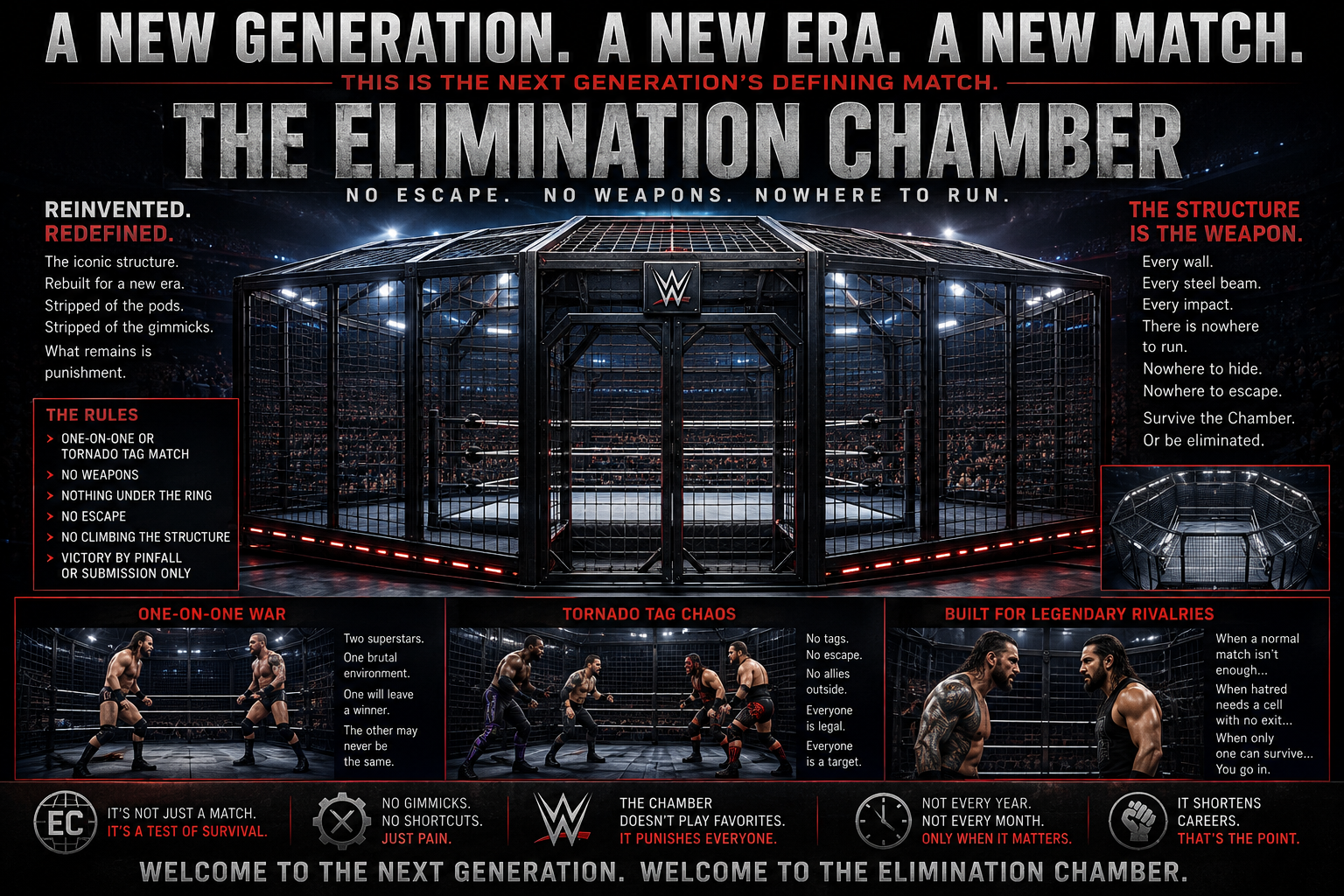
Instead of combining existing gimmicks or creating something unnecessarily dangerous, WWE could reinvent a structure it already has: the Elimination Chamber. Remove the pods and timed entrances, reinforce the structure and turn it into a brutal one-on-one or tornado tag environment with no weapons, no escape and no fighting on the roof.
Two opponents enter. The Chamber locks. Victory comes only by pinfall or submission.
Most importantly, don’t make it an annual obligation. Save it for rivalries intense enough to require it.
The Elimination Chamber would no longer be about eliminating multiple competitors.
It would be about surviving the Chamber itself.
What’s the verdict?
Every generation of professional wrestling has something that belongs to it.
A wrestler. A championship. A presentation style. A moment.
And, almost inevitably, a match.
When you look back at the history of WWE, some of the greatest eras are inseparable from the matches they either created or made famous.
During the Golden Era, there was the big blue steel cage. It was ugly. It was enormous. It looked like something somebody built out of leftover playground equipment.
And I loved it.
The New Generation helped make the ladder match into something entirely different from what wrestling fans had previously experienced. Shawn Michaels and Razor Ramon didn’t invent the ladder match, but after WrestleMania X, it became impossible to talk about one without talking about them.
That era also gave us the casket match, although I would argue that the match eventually became even more synonymous with The Undertaker and the Attitude Era that followed.
And when the Attitude Era arrived?
All hell broke loose.
Hell in a Cell.
TLC.
Hardcore matches.
Inferno matches.
Buried Alive.
Boiler Room Brawls.
WWE started looking at a wrestling ring and apparently asking:
“Okay, but how can we make this more dangerous?”
Some ideas became legendary.
Some probably should have remained on the drawing board.
But there was creativity.
There was experimentation.
And most importantly, there were matches that felt like they belonged specifically to that period of wrestling.
Then the Ruthless Aggression Era gave us another structure that became instantly recognizable.
The Elimination Chamber.
Six wrestlers.
Four pods.
Chains.
Steel.
An absolutely unforgiving floor surrounding the ring.
When that structure lowered around the ring for the first time, you knew you weren’t looking at another cage match.
You were looking at something new.
And that matters.
More recently, WWE has made WarGames one of its signature matches. WWE certainly didn’t invent WarGames during the current era—Dusty Rhodes came up with the concept decades ago—but WWE has adopted it so completely that it has become one of the defining matches of the modern product.
Which raises an obvious question.
If we’re really entering WWE’s Next Generation…
what is their match?
THAT QUESTION IS HARDER THAN IT SOUNDS
I thought this would be easy.
It wasn’t.
Come up with a new professional wrestling match.
Simple enough, right?
Until you actually try.
Professional wrestling has been around for a very long time, and wrestling promoters are apparently some of the most creatively deranged people on Earth.
Put people in a cage?
Done.
Put a roof on the cage?
Done.
Make the cage bigger?
Done.
Put two rings inside it?
Done.
Put multiple cages on top of each other?
Somebody did that too.
Hang something above the ring?
Done.
Set something on fire?
Done.
Bury somebody?
Done.
Throw them into an ambulance?
Done.
Make them climb scaffolding?
Done.
Put weapons everywhere?
Obviously done.
At some point you realize wrestling has spent decades systematically exhausting almost every possible variation of:
“What ridiculous thing can we put around, above, underneath or next to a wrestling ring?”
So I gave myself one important rule.
Whatever this match became, I didn’t want to simply combine two existing match types.
No Ladder Match inside Hell in a Cell.
No TLC Chamber.
No cage with something hanging above it.
No “Royal Rumble, except everybody has a chair.”
If we’re talking about the defining match of WWE’s Next Generation, it needs an identity of its own.
And I can absolutely promise you one other thing.
This generation’s defining match will NOT be a “something on a pole” match.
Vince Russo, wherever you are, put the pole down.
SO I STARTED LOOKING BACKWARD
When you can’t figure out where to go next, sometimes it helps to look at where wrestling has already been.
And wrestling has been to some extremely strange places.
WCW’s Tower of Doom came up.
Of course it did.
The basic concept was exactly as insane as the name suggests: multiple cages stacked vertically with wrestlers fighting their way through the structure.
Then you start looking internationally and things get considerably more disturbing.
Japanese deathmatch wrestling alone could provide enough material for an entire issue of Pro Wrestling 911.
Scaffold matches.
Exploding rings.
Barbed wire.
Electricity.
Glass.
And yes…
Piranhas.
There has actually been a piranha death match.
At some point “professional wrestler” apparently wasn’t dangerous enough as an occupation, so somebody decided to introduce carnivorous fish.
That’s where I draw the line.
Because whatever WWE creates for its next generation, I don’t want the selling point to be that somebody could legitimately die doing it.
There’s a difference between creating the illusion of danger and unnecessarily creating actual danger.
Professional wrestling is already dangerous enough.
These wrestlers are already taking bumps that most of us wouldn’t take for six figures.
The goal should be creating a structure that looks terrifying, feels different and allows wrestlers to tell stories we haven’t seen a thousand times before.
Not designing something that requires an emergency room to be included in the production budget.
So I narrowed the search.
Forget weapons.
Forget explosions.
Forget scaffolds.
Forget fish.
I started looking specifically at structure matches.
What could become this generation’s Hell in a Cell?
That’s when I found something interesting.
DOMO DE LA MUERTE
AAA has experimented with a structure called Domo de la Muerte—essentially a domed steel enclosure surrounding the ring.
And considering WWE’s relationship with AAA under the TKO umbrella, it’s now part of a wrestling ecosystem considerably closer to WWE than it once was.
But I wouldn’t simply take Domo de la Muerte and put it on WWE television.
For one thing, if the entire point of this exercise is giving the Next Generation something of its own, simply importing somebody else’s match doesn’t accomplish that.
And frankly?
I wasn’t particularly impressed with the structure itself.
Interesting concept.
Not the answer.
But looking at it made something click.
I was thinking about this the wrong way.
WWE doesn’t necessarily need to build an entirely new structure.
It already has one.
One of the most recognizable structures in professional wrestling.
Maybe instead of inventing another giant piece of steel…
WWE should reinvent the Elimination Chamber.
TEAR THE CHAMBER APART
Think about the Elimination Chamber for a moment.
What defines it?
The pods.
Six competitors.
Two begin the match.
Four wait inside their chambers.
People enter at timed intervals.
Eventually everybody is released.
Competitors are eliminated through pinfall or submission until one remains.
That’s the Elimination Chamber match.
But what if we removed all of that?
Take out the pods.
Take out the six-person format.
Take out the timed entrances.
Take out the staggered releases.
Strip the concept down until all that remains is the structure itself.
A ring.
Surrounded completely by steel.
Then rebuild the Chamber specifically for one-on-one combat.
Now we’re getting somewhere.
THE NEW ELIMINATION CHAMBER
Picture the current Elimination Chamber descending over the ring.
But immediately something looks wrong.
There are no pods.
There are no waiting competitors.
There aren’t six wrestlers standing outside waiting to enter.
There are two.
That’s it.
Two wrestlers walk inside.
The door closes.
And nobody else is coming.
The redesigned Chamber would be a much more solid structure than the current version.
Not a giant chain-link fence.
Not something designed to be climbed.
Not something designed to create escape sequences.
A brutal enclosed fighting environment.
The ring remains in the center.
The surrounding floor remains part of the Chamber.
But the entire presentation becomes darker, tighter and more claustrophobic.
This isn’t a playground.
It’s a prison.
AND HERE’S THE MOST IMPORTANT PART
There are no weapons underneath the ring.
None.
That may sound like a minor detail.
I think it’s one of the most important rules.
One of the problems with modern “brutal” wrestling matches is that eventually they can become scavenger hunts.
Someone rolls outside.
Reaches under the ring.
Chair.
Table.
Kendo stick.
Another table.
Another chair.
Bag of thumbtacks.
Toolbox.
Fire extinguisher.
At some point you’re waiting for somebody to pull a microwave out from underneath the damn ring.
I don’t want that.
The Chamber itself should be the weapon.
That’s what made the original Hell in a Cell concept so effective.
The environment was dangerous.
The structure mattered.
So before the Chamber lowers, ringside is cleared.
Nothing underneath the ring.
No tables.
No chairs.
No kendo sticks.
No conveniently positioned toolbox.
Just two wrestlers and the structure.
You want to hurt somebody?
Use the Chamber.
NO ESCAPE
And unlike Hell in a Cell, there is no breaking through the cage.
No door accidentally getting opened.
No conveniently placed bolt cutters.
No section of the wall that mysteriously gives way because somebody gets thrown into it.
Once the Chamber closes, it stays closed.
Period.
That becomes one of the defining characteristics of the match.
Hell in a Cell eventually developed an interesting problem.
Some of its most famous moments happened outside Hell in a Cell.
Mick Foley being thrown off the top.
People climbing the structure.
Fighting on the roof.
Breaking through panels.
Those moments are legendary.
I’m not taking anything away from them.
But because they happened, audiences eventually started expecting them.
The structure stopped being purely about trapping two people together and became partially about wondering when they were going outside.
This Chamber goes in the opposite direction.
Nobody gets out.
That’s the entire point.
AND NOBODY GOES UP
There should be no fighting on top of the structure.
None.
Don’t design it to support wrestlers.
Don’t create an obvious climbing path.
Don’t tease it.
Don’t do the inevitable spot where somebody reaches the roof and Michael Cole starts screaming about how dangerous it is.
We’ve seen it.
Hell in a Cell owns that imagery.
Let Hell in a Cell keep it.
The new Chamber needs its own identity.
Its danger isn’t height.
Its danger is confinement.
There is nowhere to run.
There is nowhere to escape.
There is nowhere to retrieve a weapon.
There is nowhere else for the match to go.
Two wrestlers enter.
One wrestler wins.
MAKE THE STRUCTURE FEEL SOLID
This is where I would physically redesign the Chamber.
Not completely.
You still need to look at it and immediately recognize its ancestry.
But make it heavier.
More industrial.
More imposing.
Instead of large expanses of chain, use more solid steel framing.
Smaller reinforced sections.
Heavy panels around portions of the perimeter.
Everything should look like it hurts.
The Chamber shouldn’t look like something wrestlers are supposed to climb.
It should look like something they’re supposed to survive.
Imagine somebody being powerbombed against one of those walls.
Imagine Gunther chopping somebody against a steel panel with nowhere for them to retreat.
Imagine Oba Femi throwing somebody across the Chamber floor.
Imagine Bron Breakker hitting a spear with his opponent trapped between him and the structure.
Imagine a wrestler desperately trying to create distance and realizing there isn’t any.
That’s the psychology.
THE CHAMBER BECOMES CLAUSTROPHOBIC
Hell in a Cell is enormous.
That’s part of its visual identity.
The new Chamber should feel different.
It should feel claustrophobic.
Not unsafe.
There’s an important distinction.
WWE would obviously need enough clearance for performers to work safely.
But visually, I want the audience to feel like the walls are right there.
Camera angles should emphasize it.
Shoot through the steel.
Let the lighting cast shadows across the ring.
Keep the audience visible but slightly obscured.
When somebody gets thrown into the structure, let the sound carry through the arena.
BANG.
No music.
No weapons.
No explosions.
Just steel.
The match should sound violent.
ONE-ON-ONE SHOULD BE THE DEFAULT
The primary version should be one-on-one.
That’s important.
The existing Elimination Chamber is inherently chaotic.
Six wrestlers.
Pods opening.
Temporary alliances.
Multiple eliminations.
Bodies everywhere.
This should be the opposite.
Personal.
Two people.
If WWE reaches the point where two wrestlers legitimately hate each other and a normal match can’t settle it, this is where they go.
Not because February arrived.
Not because WWE happens to have an Elimination Chamber PLE scheduled.
Because the story requires it.
That’s another major change I would make.
STOP NAMING EVENTS AFTER MATCHES
I’ve already made this argument elsewhere in this issue, but it applies perfectly here.
Get rid of the Elimination Chamber PLE.
Not the match.
The event.
The same philosophy applies to Hell in a Cell and Money in the Bank.
Specialty matches shouldn’t happen because they’re printed on WWE’s calendar.
They should happen because the story demands them.
If there isn’t a rivalry worthy of the Chamber this year?
Don’t have one.
If two years pass without one?
Fine.
That makes the next one bigger.
Imagine watching Raw and suddenly the General Manager announces:
“There’s only one way this ends. Elimination Chamber.”
If you haven’t seen that structure in eighteen months, the reaction is completely different.
That’s what makes specialty matches special.
Scarcity.
TORNADO TAGS COULD WORK TOO
There is one variation I would allow.
Tornado tag.
Four wrestlers.
Two teams.
Everyone inside at the same time.
No tags.
No pods.
No waiting.
No escape.
That could be incredible.
But again, it should be rare.
Maybe two teams have been destroying each other for months.
Normal tag matches haven’t worked.
People keep interfering.
Partners keep saving each other.
Then put all four inside the Chamber and lock the door.
Now the environment changes tag-team strategy completely.
There is nowhere for the illegal partner to stand because there is no illegal partner.
Everybody is legal.
Everybody is fighting.
It becomes organized chaos inside a structure designed to contain it.
That could give the Chamber a second identity without turning it into another gimmick overloaded with variations.
Singles.
Tornado tag.
That’s enough.
HOW DO YOU WIN?
Here’s where I would resist the temptation to overcomplicate things.
Pinfall.
Submission.
That’s it.
No escape victory.
No ten-count.
No retrieving an object.
No special scoring system.
No button.
No flag.
No complicated explanation that requires Michael Cole to spend five minutes reading rules before the bell.
The match itself is already different because of the environment.
You don’t need to reinvent how professional wrestling works at the same time.
Beat your opponent.
Pin them.
Make them submit.
The structure simply makes getting there considerably worse.
WHY STILL CALL IT THE ELIMINATION CHAMBER?
Some people would probably argue that if you remove the pods and the elimination format, it shouldn’t still be called the Elimination Chamber.
Fair argument.
But I would keep the name.
Because now “Elimination” means something different.
You’re not eliminating five other competitors.
You’re trying to eliminate the person standing across from you.
And perhaps, over time, you’re eliminating something else.
Years from their career.
That sounds dramatic.
It should.
Because that’s how WWE should sell the match.
Not literally, obviously.
The goal isn’t actually to shorten someone’s career.
The Elimination Chamber becomes WWE’s ultimate test of physical punishment.
Commentators talk about what it takes out of people.
Wrestlers hesitate before agreeing to enter.
Some refuse.
Others demand it.
And when somebody challenges another wrestler to the Chamber, the audience understands what they’re saying:
I don’t just want to beat you. I want nowhere left for you to go.
That’s a wrestling story.
DON’T OVERUSE IT
This is probably the most important part of the entire concept.
Do.
Not.
Overuse.
It.
WWE has a bad habit of creating something special and then putting it on a schedule.
That’s how special becomes ordinary.
The Next Generation Chamber shouldn’t be guaranteed every year.
There shouldn’t be an annual February countdown.
There shouldn’t be promotional graphics six months ahead advertising “Elimination Chamber 2029.”
Let stories determine when it happens.
Maybe there are two Chamber matches one year.
Maybe there are none the next.
Maybe five years from now there’s a rivalry so intense that everybody knows exactly what match needs to happen before WWE even announces it.
That’s when you’ve succeeded.
When fans start chanting for the match because the story earned it.
THIS DOESN’T REPLACE HELL IN A CELL
Hell in a Cell can still exist.
That’s important.
I’m not arguing that WWE should retire every match created before 2026.
Hell in a Cell has history.
Keep it.
But use it differently.
Hell in a Cell has become associated with spectacle.
The enormous structure.
Weapons.
Breaking through walls.
Climbing to the roof.
Falls.
Huge moments.
Let it be that.
The new Chamber becomes something else.
No escape.
No roof fighting.
No weapons.
No spectacle for spectacle’s sake.
Just punishment.
Hell in a Cell feels enormous.
The Chamber feels suffocating.
Hell in a Cell asks:
How far will these wrestlers go?
The Chamber asks:
How much can these wrestlers take?
Now both structures have reasons to exist.
THE FIRST ONE MATTERS
And if WWE ever did something like this, the first match would be critical.
You only get one opportunity to introduce a match.
Think about the first Elimination Chamber.
The first Hell in a Cell.
The first TLC match.
Those matches established expectations.
So don’t debut this on a random episode of Raw because ratings are down.
Build it.
Tease the redesigned structure without showing everything.
Show steel being fabricated.
Show pieces arriving at the arena.
Don’t explain exactly what we’re looking at.
Then eventually reveal it.
And most importantly, choose the right wrestlers.
The first match needs people who can establish the Chamber’s identity.
Not people who are going to immediately spend twenty minutes trying to figure out how to climb it.
People who can make the environment feel brutal.
Oba Femi immediately comes to mind.
Gunther.
Bron Breakker.
There are several possibilities.
But whoever gets that first match carries an enormous responsibility.
They’re not simply having a feud.
They’re teaching the audience how this match works.
DON’T CHASE THE MICK FOLEY MOMENT
This is another trap WWE has to avoid.
Every dangerous structure doesn’t need somebody falling from twenty feet.
The original Hell in a Cell produced one of wrestling’s most famous images when Mick Foley went off the structure.
You cannot manufacture that again.
Stop trying.
The next iconic wrestling moment may be completely different.
Maybe it’s somebody repeatedly throwing an opponent into a steel wall until the audience becomes uncomfortable.
Maybe it’s a wrestler refusing to submit despite being trapped against the structure.
Maybe it’s a spear that sends both competitors crashing into a reinforced panel.
Maybe it’s something neither of us has imagined yet.
That’s the beauty of giving talented wrestlers a new environment.
They’ll discover things.
That’s how innovation actually happens.
Build the playground.
Establish the rules.
Then let creative wrestlers figure out what the hell they can do with it.
EVERY GENERATION DESERVES SOMETHING OF ITS OWN
That’s ultimately why I want this.
Not because WWE desperately needs another cage.
It doesn’t.
Wrestling has enough cages.
I want the Next Generation to have something that becomes associated with them.
When somebody sees that big blue cage, they think about another era.
When someone sees a ladder suspended over a ring, certain matches immediately come to mind.
Hell in a Cell belongs to an era.
TLC belongs to an era.
The Elimination Chamber belongs to an era.
WarGames has been reborn for another.
Twenty years from now, I want wrestling fans to look back at something Oba Femi, Trick Williams, Carmelo Hayes, Dominik Mysterio or another member of this generation did and say:
“That match defined their era.”
Maybe the answer isn’t inventing something completely from scratch.
Maybe the answer has been hanging above WWE’s ring this entire time.
Take the Elimination Chamber.
Remove the pods.
Remove the countdowns.
Remove the revolving-door competitors.
Clear everything from underneath the ring.
Reinforce the structure.
Make it solid.
Make it claustrophobic.
Put two people inside.
Lock the door.
And don’t open it again until one of them wins.
No escape.
No weapons.
No roof.
No gimmicks piled on top of gimmicks.
Just a wrestling ring surrounded by an unforgiving structure designed to make every impact worse.
And yes, call it the Elimination Chamber.
Because after spending thirty minutes inside that thing, the winner may have eliminated his opponent from the championship picture.
The loser may have eliminated a few years from his career.
And both of them may leave having created something wrestling fans remember for the next twenty years.
Every generation deserves its match.
This could be theirs.
:::
Add a Comment
Jump into the discussion. AI-seeded comments are clearly labeled; reader comments are not.
Add a Comment
Jump into the discussion. AI-seeded comments are clearly labeled; reader comments are not.