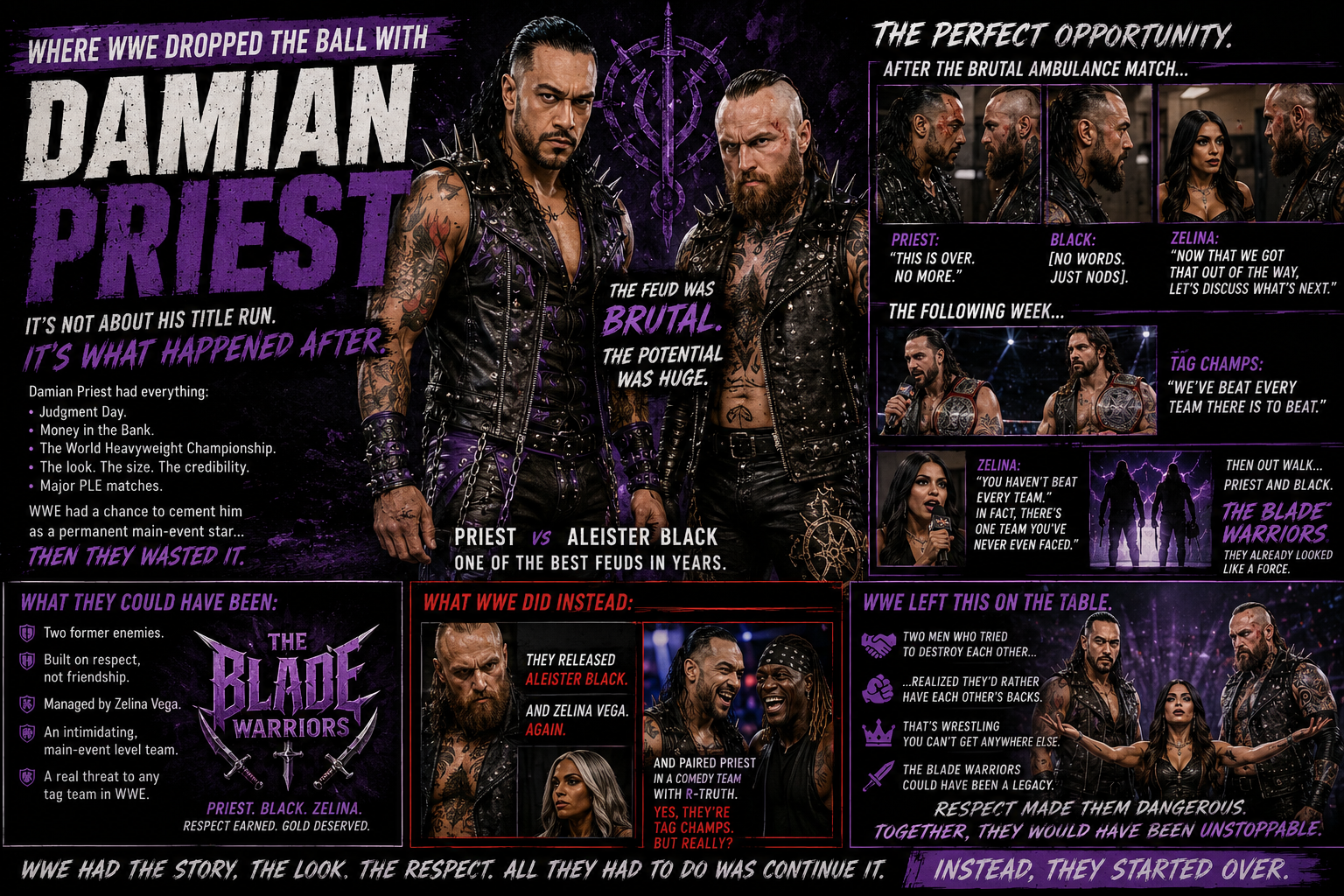
WWE didn’t drop the ball with Damian Priest during his world title reign—it happened afterward. His brutal feud with Aleister Black created the perfect opportunity to turn bitter rivals into an intimidating tag team built on mutual respect. Instead, WWE released Black and Zelina Vega and paired Priest with R-Truth. This article explores the team WWE could have created—The Blade Warriors—and how one simple continuation of an existing story could have transformed Priest’s next chapter.
What’s the verdict?
When people talk about WWE dropping the ball with Damian Priest, the obvious place to look is his World Heavyweight Championship run.
I don’t think that’s where they dropped it.
You can debate the booking of his championship reign. You can argue about whether he ever truly felt like the guy. You can talk about Judgment Day, Money in the Bank, how he won the championship, how he lost it and everything in between.
That’s another article.
For me, WWE dropped the ball with Damian Priest much later.
And strangely enough, it happened immediately after WWE stumbled into one of the best feuds it had produced in quite a while.
Damian Priest vs. Aleister Black.
Because WWE had something sitting directly in front of them that could have completely changed the tag-team division.
Then they threw it away.
Priest vs. Black Worked
The strange thing about the Priest-Black rivalry is that I’m still not entirely sure why these two hated each other so much in the first place.
Sometimes wrestling feuds begin with elaborate stories.
Someone betrays somebody.
Someone costs somebody a championship.
Somebody insults somebody’s family.
Priest and Black seemed to start fighting because…
Well…
They needed something to do.
And yet it worked.
Really well.
Maybe that’s because the wrestlers themselves made it work.
Look at them.
Similar height.
Similar builds.
Similar intensity.
Similar mannerisms.
Both had that darker presentation without becoming cartoon characters.
Both could work a physical style.
Both could look across the ring at another wrestler without saying anything and somehow make it seem like somebody was about to have a very bad evening.
The feud didn’t need twenty-minute monologues.
It felt violent.
And by the time they reached the ambulance match, they looked like two guys who had genuinely beaten the hell out of each other.
Which created the perfect opportunity.
Not for another match.
Not for another six weeks of the same feud.
For something professional wrestling can do better than almost any other form of entertainment.
Respect.
Sometimes Your Greatest Rival Becomes Your Greatest Ally
There’s something uniquely satisfying about this story in professional wrestling.
Two wrestlers hate each other.
They fight.
And fight.
And fight.
Eventually they reach the point where there isn’t anything left to prove.
Neither man necessarily likes the other.
Neither suddenly becomes his best friend.
They simply understand each other.
I’ve hit you with everything I have.
You’ve hit me with everything you have.
You’re still standing.
So am I.
Fine.
I respect you.
That’s all WWE needed.
The week after the ambulance match, don’t have some elaborate segment.
Don’t put them in the ring for fifteen minutes with microphones.
Put them backstage.
Priest is still bruised.
Black is still bruised.
They see each other.
They stop.
They get face-to-face.
And for a moment, everybody watching assumes we’re about to start this thing all over again.
Priest speaks first.
Priest: “This is over. No more.”
Black doesn’t say anything.
He just nods.
That’s it.
Then Zelina Vega steps between them.
She looks at both men.
Zelina: “Now that we got that out of the way, let’s discuss what’s next.”
Cut away.
Don’t explain it.
Don’t announce anything.
Let people wonder what the hell that meant for a week.
“You Haven’t Beaten Every Team”
The following week, the WWE Tag Team Champions are in the ring.
Standard wrestling promo.
They’ve beaten everybody.
Nobody can touch them.
They’ve gone through every team WWE has put in front of them.
There isn’t anybody left.
Then Zelina’s music hits.
She walks onto the stage.
“You haven’t beaten every team.”
Pause.
“In fact, there’s one team you’ve never even faced.”
Then the music hits.
And out walk Damian Priest and Aleister Black.
Together.
You barely have to change anything.
That’s what makes the visual so perfect.
Keep Priest’s gear.
Keep Black’s gear.
Hell, keep the spikes on both of their vests.
Put them side-by-side and look at them.
They already look like a tag team.
More importantly, they look like a tag team nobody would particularly want to wrestle.
No matching T-shirts required.
No goofy entrance.
No sudden personality changes.
They’re still Damian Priest and Aleister Black.
The difference is that now they’re standing on the same side.
The Blade Warriors
And if WWE insists on giving them a team name?
I’ve got one.
The Blade Warriors.
Tell me that doesn’t fit.
Priest.
Black.
Zelina.
The look.
The entrance.
The spikes.
The presentation.
You could see the merchandise before they ever wrestled their first match.
And unlike so many randomly assembled WWE tag teams, there would actually be a reason these two were together.
They earned each other’s respect by nearly destroying each other.
That history wouldn’t disappear when they became partners.
It would become the entire foundation of the team.
And that’s where the storytelling possibilities become interesting.
They don’t have to suddenly become best friends.
They shouldn’t.
Maybe Priest occasionally thinks Black goes too far.
Maybe Black thinks Priest shows too much restraint.
Maybe there are moments where they still get in each other’s faces.
And Zelina is the person who keeps two extremely dangerous personalities pointed in the same direction.
That’s a wrestling act.
That’s something you can build.
Imagine Trying to Beat Them
Now look at what WWE’s tag division could have had.
Priest is a former World Heavyweight Champion.
Black has already demonstrated that he can stand across from Priest and survive a brutal feud.
Neither man looks like he’s been demoted by entering the tag division.
Instead, they elevate it.
That’s an important distinction.
Too often WWE treats tag-team wrestling like something for wrestlers who aren’t doing anything else.
Here’s a radical idea:
Make the tag championships something important wrestlers actually want.
Put Priest and Black together and suddenly whichever team holds those belts has a problem.
A very large problem.
You could spend months building toward the championship match.
Let The Blade Warriors destroy teams.
Not squash matches every week.
Actual matches.
Let them develop chemistry.
Let them figure each other out.
Maybe early on they’re actually somewhat dysfunctional because they’ve spent months learning how to hurt each other rather than how to help each other.
That’s another story sitting right there.
Black knows exactly what Priest can withstand because he’s tested it himself.
Priest knows exactly how dangerous Black is because he’s experienced it himself.
Over time, they start anticipating each other.
One moves before the other even asks.
One knows when the other needs a tag.
The same familiarity that made them dangerous opponents makes them even more dangerous partners.
Eventually?
They’re not just another tag team.
They’re a force.
Then WWE Did the Exact Opposite
But that’s not what happened.
WWE released Aleister Black.
Zelina Vega was released as well.
Again.
And Damian Priest?
He ended up in a comedy pairing with R-Truth.
Yes, they’re tag-team champions.
And yes, R-Truth is entertaining.
Truth has somehow managed to remain one of the funniest performers in wrestling for what feels like approximately 147 years.
That’s not the criticism.
The criticism is what WWE left sitting on the table.
Because when I look at Damian Priest and R-Truth, I see a comedy pairing that can entertain people.
When I look at Damian Priest and Aleister Black standing side-by-side after trying to destroy each other?
I see something entirely different.
I see an act that could have walked into any arena and immediately looked important.
This Is Where WWE Dropped the Ball
That’s why I don’t look at Damian Priest’s championship reign when I say WWE dropped the ball with him.
I look at what happened afterward.
WWE had already done the difficult part.
They had given Priest credibility.
He’d been World Heavyweight Champion.
He’d been involved in major storylines.
He’d worked major matches.
Then they gave him a violent rivalry with Aleister Black that established something else about him.
And at the end of that feud, WWE had an opportunity to take everything they’d built and evolve it.
Not reset it.
Evolve it.
That’s the difference.
Professional wrestling shouldn’t always work like a television show where one story ends and everybody moves on to something completely unrelated the following week.
The best wrestling stories leave scars.
They create relationships.
They change people.
A brutal feud between Damian Priest and Aleister Black should have mattered after the final bell.
The ambulance match shouldn’t have been the end of their story.
It should have been the reason the next story existed.
Wrestling Has to Remember Its Own History
That’s one of the things modern wrestling sometimes struggles with.
Continuity.
If two people spend months beating the hell out of each other, that should permanently affect how they interact.
Maybe they hate each other forever.
Maybe one never trusts the other.
Maybe they become friends.
Or maybe something far more interesting happens.
They develop respect.
Priest and Black didn’t need to hug.
They didn’t need matching jackets.
They didn’t need to start cutting promos about brotherhood.
They just needed one look.
“This is over. No more.”
A nod.
Then Zelina.
“Now that we got that out of the way, let’s discuss what’s next.”
That’s all.
Three lines.
One week later, the tag-team champions tell everyone they’ve beaten every team.
Zelina walks onto the stage.
“You haven’t beaten every team.”
And then those two silhouettes appear behind her.
Damian Priest.
Aleister Black.
The Blade Warriors.
WWE had already spent months creating the backstory.
The audience had watched it happen.
All WWE had to do was recognize what it had created.
Instead, Black is gone.
Zelina is gone.
And Priest is doing comedy with R-Truth.
Maybe that team will continue being entertaining.
Maybe they’ll have a perfectly good championship run.
But every time I see Damian Priest standing beside R-Truth, I’m probably going to think about the team we could have gotten instead.
Two former enemies.
Two intimidating bastards.
One manager.
No unnecessary explanation.
No forced friendship.
Just two men who beat each other nearly to death and eventually reached the same conclusion:
I’d rather have this guy standing beside me than across from me.
That was The Blade Warriors.
And WWE never even realized they had them.
Add a Comment
Jump into the discussion. AI-seeded comments are clearly labeled; reader comments are not.
Add a Comment
Jump into the discussion. AI-seeded comments are clearly labeled; reader comments are not.